Including Original "Paul H. Letters" Copyright © 1996-2025 Paul V. Heinrich / website © 1996-2025 Dirk Ross - All rights reserved.


Tuesday, 20 July 2004

Where Were You When It Happened 35 Years Ago.?

Where Were You When It Happened 35 Years Ago.?

Paul H bristolia at yahoo.com
Tue Jul 20 01:08:21 EDT 2004

The questions are: "Where were you when
Neil Armstrong first stepped out on the
Moon 35 years ago?" "Where did you watch
it and with whom?"

35 Years Ago Tuesday Men First Stepped Foot on the
Moon
By My Wise County, My Wise County, Virginia
http://www.mywisecounty.com/news/071904-2.htm

First walk on the moon remembered 35 years later
CTV, Canada
http://www.ctv.ca/servlet/ArticleNews/story/CTVNews/1090020187109_3?hub=SciTech


Commentary: US remains lost in space
By Martin Sieff, United Press International
Published 7/19/2004 5:30 PM
http://www.upi.com/view.cfm?StoryID=20040719-045828-8640r


Yours,

Paul
Baton Rouge, LA

Monday, 19 July 2004

Mysterious Rosicrucian Meteorite - What Was It?

Mysterious Rosicrucian Meteorite - What Was It?

Paul H bristolia at yahoo.com
Mon Jul 19 20:08:19 EDT 2004

I was searching through Google News Search Engine to
see if I could find anything more about the story of
the alleged fireball that set fire to the vollage in Egypt.
Instead the keywords "Egypt" and "meteorite" gave
me the following article:

"Rosicrucians make pilgrimage to San Jose"
Biloxi Sun Herald, MS, Jul. 03, 2004
http://www.sunherald.com/mld/sunherald/news/nation/9075308.htm.

Talking about the Rosicrucians' headquarters, it
stated:

"For generations of San Joseans, it's
an eclectic theme park incongruously
set in an otherwise ordinary neighborhood
of leafy streets and picturesque homes.
Its onion-domed planetarium, statue of
Pharaoh Thutmose III, 60-foot obelisk
and Egyptian-style buildings with
hieroglyphs and columns recall school-
day field trips."

Talking about children taking these fieldtrips, it
stated:

"Later, as adults, they may have strolled
its lush gardens or read about the mystery
of the missing 209-pound meteorite. (The
exhibit, which had been on display 40
years, was stolen by a former security
contractor and never found.)"

A 209 pound meteorite sounds like an awfully large
meteorite to have disappeared into thin air.

Does anyone know about the history of this meteorite
as to where it was found, type of meteorite, when
it was stolen, and so forth?

Yours,

Paul
Baton Rouge, LA

Wednesday, 7 July 2004

Loaves and fishiness

Loaves and fishiness

Paul H bristolia at yahoo.com
Wed Jul 7 22:51:57 EDT 2004

Marc D. Fries wrote:


>I'm rather intrigued with Shirokovsky.


Yes, I agree, it is an interesting X-File type of
object. I might track down some metallurgists,
whom I know, to see what they have to say. Also, my
Russian wife can translate into and type letters
in Russian on my Russified Mac, if needed.


>In looking at the pictures, a couple of things

>jump out - first off, most of the pieces are shaped

>like loaves of bread, or like ingots.


In terms of being "...then sand-cast the resulting
melt into fine sand pre-forms roughly pounded out
to look like meteorites.", they seem to be too
ingot-like to have been made as deliberate fakes
formed to look like meteorites. To me, the ingot-like
forms suggest some sort of industrial by-product,
not something shaped to deceive. My (naive?)
impression is that we are dealing with self-delusion
on a massive scale instead of fraud.

That the olivines are of a type associated with Ni-Cu
ores and of the approximate age of Ni-Cu ores
associated such deposits suggests to me that whatever
created the Shirokovsky material might have something
to do with the smelting of such ores. The local Ural
olivines are far too old and not associated with
Ni-Cu ores from what I can tell and, thus can't be
their source. If Shirokovsky was made simply as a
fake,
the people involved logically wouldn't have ignored
local olivines,in favor of more distance olivines
associated with the Ni-Cu ores.

(Also, it doesn't look like it has been underwater
for 44 years. (Of course the water is cold, but
still there should be some obvious corrosion.)


>Secondly, the comment that the olivines did not

>equilibrate with the metal matrix, but rather

>"cooled quickly in a strongly oxidizing environment"

>is interesting. An oxidizing environment such as

>...air??


This is a devasating argument. Quick cooling
in an oxidizing environment certainly puts the
stake in heart, as if it was needed, of the
meteorite interpretation.

Also, I get the feeling that the promoters of it make
much of a nonexistent connection between the hole
in the ice and what was found on the bottom of the
reservoir. Given that the fall happened in 1956, how
do they know exactly where to search in 2002 some
44 years later? Are there any records of someone
determining the location of the hole in 1956 with a
survey before the ice melted?

It would be interesting to find out what sort
boat and barge traffic uses the Kosva River near
Shirokovsky. If there is any sort of commercial
or industrial traffic, there is almost an
unlimited variety of stuff that could get dumped
into the reservoir. I suspect the promoters of this
material as a meteorite likely don't realize that
all sorts of really weird stuff gets dumped into
reservoirs.

Yours,

Paul
Baton Rouge, LA

Shirokovsky - Some Thoughts

Shirokovsky - Some Thoughts

Paul H bristolia at yahoo.com
Wed Jul 7 01:22:44 EDT 2004

Peter Marmet wrote:


>as far as I know, the lastest info is still this

>special statement of the meteoritical society:


http://www.meteoriticalsociety.org/bulletin/shirokovsky.pdf
"

One really curious thing about the Shirokovsky
material is that its K-Ar age of the olivine is
"about 270 million years". This is curious because
there are metalliferous ultramafic rocks of that age,
which contain dunite, a rock composed entirely of
olivine.

What is also most curious is that Au, Ir, and Os of
the olivine is typical of olivine found in Cu-Ni
deposits. It is curious because, there are large
ultramafic Cu-Ni ore deposits that occur in Russia
which contain olivine-rich rocks. For example,
there are "seven major ore deposits associated
with the basal portions of such olivine rich
intrusives" in the Noril'sk / Talnakh Ni-Cu-PGE
(Platinum-Group Elements) ore deposits. By coincidence

or not, these olivine-rich intrusives are part of
subsurface sills associated with extensive flood
basalt accumulations, called the "Siberian Traps",
is about 251 million years in age, which is quite
close to the "about 270 million years age" of the
Shirokovsky material. The inexact age determination
made on it, could be off by 20 million years.

Within the Central Urals, there are numerous
ultramafic
complexes that contain dunites associated with rich
chromite and PGE (Platinum-Group Elements)
mineralization and ores. Any of these could be
potential nearby sources of the olivine, which might
have been associated with ore being transported or
smelted.

Given the detailed analyses of the olivine in the
Shirokovsky material, a person should be able to
determine whether any potential / possible source for
the olivine described in the above Meteoritical
Society Report exists within Russia.

mark ford wrote:


>In all the pictures I have seen, to me

>it doesn't quite seem right for a

>pallasite the crystals look a bit too

>sharp and pointed', (just an observation)

>anyone agree with me?


I agree completely with you. Go read "[meteorite-
list] Shirokovsky Texture - A Red Flag As to Its
Origin??" at:

http://six.pairlist.net/pipermail/meteorite-list/2003-June/091826.html

There I stated:

" I have been looking at a number of pictures of
fragments of Shirokovsky that were shown on
various web pages and pictures of pallasites.
After comparing them, there appears to be, in
my opinion, a rather drastic difference in the
texture of the olivine grains within each. In the
pallasites, indvidual grains are equant and either
rounded or euhedral. Also, in the pallasites, a
person can find examples of olivine grains that
have coalesced together.

Examples of this texture can be seen at:

http://www.meteoriteman.com/collection/thiel.htm
http://www.meteoriteman.com/collection/dora.htm
http://www.meteoriteman.com/collection/mtvernon.htm
http://meteorites.asu.edu/pallasite.jpg

In comparison, pictures of the pieces of
Shirokovsky that I have found have a different
texture. the olivine crystals are far more angular
and variable in outline than found in the pallasites,
for which I found pictures. In fact, some of the
olivine pieces in pictures of Shirokovsky are even
flat rectagular blades quite unlike anything seen
in true pallasites. In addition, I don't see any of
the merged / coalesced olivines seen in other,
Overall, the Shirokovsky has the appearance of a
terrazzo floor made up of fragmented rocks."

Yours,

Paul
Baton Rouge, LA

Monday, 5 July 2004

Fires Threaten Graham Mountain Observatory (Arizona)

Fires Threaten Graham Mountain Observatory (Arizona)

Paul H bristolia at yahoo.com
Mon Jul 5 23:51:32 EDT 2004

Fire still threatens Arizona observatory
Washington Times, DC -
http://washingtontimes.com/upi-breaking/20040705-021707-9766r.htm

"Phoenix, AZ, Jul. 5 (UPI) -- A stubborn wildfire in
southern Arizona remained a threat Monday to the Mount

Graham Observatory, considered one of the top
astronomy
sites in the nation."

Two wildfires threatening observatory and houses
http://www.10tv.com/Global/story.asp?S=1999424

Yours,

Paul

Wednesday, 30 June 2004

Original "Meteorite Kills(Fill in Blank)" Story Appears in WWW

Original "Meteorite Kills(Fill in Blank)" Story Appears in WWW

Paul H bristolia at yahoo.com
Wed Jun 30 19:33:28 EDT 2004

While waiting in the local checkup line, I noticed
that this week's Weekly World News (WWW) has one of the
latest versions of the "Falling Meteorite kills (fill
in the blank) story. The headline reads, "Meteorite
Flattens Pope". In the tradition of the Weekly World
News, it is quite a shaggy dog story complete with
fake photographs. The people, who publish the WWW must be
really strange people.

Yours,

Paul

Wednesday, 23 June 2004

paper About Tunguska Event Impactor

paper About Tunguska Event Impactor

Paul H bristolia at yahoo.com
Wed Jun 23 13:34:50 EDT 2004

In the March (2004) issue of Planetary and Space
Science, there is a paper discussing the identity
of the impactor, which produced the Tunguska Event,
that might be of interest to some list members.
The paper is:

Q. L. Hou , E. M. Kolesnikov , L. W. Xie , N. V.
Kolesnikova , M. F. Zhou and M. Sun, 2004,
Platinum group element abundances in a peat layer
associated with the Tunguska event, further
evidence for a cosmic origin. Planetary and
Space Science. vol. 52, no. 4, pp. 331-340
doi:10.1016/j.pss.2003.08.002

Based upon "excess" Pd, Rh, Ru, REE, Co, Sr, and Y
found in a peat column from the Northern peat bog
of the 1908 Tunguska explosion site, they concluded
that the impactor, which created the Tunguska event
was "more likely a comet", although the possibility
that the impactor might have alternatively been a
carbonaceous asteroid. They estimated that the
mass of either the comet or carbonaceous asteroid
was as large as 103-106 tons.

I am only reporting what this paper stated. I don't
know enough about the pro and cons of the various
arguments about the Tunguska event to evaluate
their conclusions in any intelligent manner. If
anybody needs more information, he or she can
find contact information for the authors by
clicking the link, "Volume 52, Issue 4, pp. 259-340
(March 2004)" at:

http://www.sciencedirect.com/science/journal/00320633

and following the article link to the abstract.

(Besides my library doesn't subscribe to Planetary
and Space Science. Thus, I only have access to the
article's abstract.)

Yours,

Paul

Friday, 4 June 2004

Security Cameras and Washington Fireball

Security Cameras and Washington Fireball

Paul H bristolia at yahoo.com
Fri Jun 4 09:34:38 EDT 2004

In the post "Washington Fireball" mark ford wrote:


> http://www.komonews.com/stories/31552.htm


>Film footage showing the Washington meteor

>illuminating the ground on security cameras

>... this is the real deal...


On these security camera tapes of the fireball,
there are some well-defined shadows of trees
and other objects. If the location of these
security cameras were known, couldn't the
shadows shown in the tape be used to precisely
determine the position of the fireball relative
to the cameras?

Just Curious

Yours,

Paul
Baton Rouge, LA

Wednesday, 2 June 2004

Looking for Map of Meteorite Finds in Eastern US

Looking for Map of Meteorite Finds in Eastern US

Paul H bristolia at yahoo.com
Wed Jun 2 16:07:58 EDT 2004

Is there any published map that shows the
distribution of meteorite finds in the United
States in the area of North Carolina, South
Carolina, Kentucky, Tennessee, and northern
Alabama and Mississippi?

Yours,

Paul
Baton Rouge, LA 70803

Thursday, 27 May 2004

what is the world standards for petrographical preparations (polarization microscopy)

what is the world standards for petrographical preparations (polarization microscopy)

Paul H bristolia at yahoo.com
Thu May 27 20:44:16 EDT 2004

E. L. Jones jonee at epix.net wrote:


>I am also interested in the use of "quartz"

>as index markers. This isn't in any of my

>reference books. Are they attached to the

>specimen and ground at the same time as the

>thin section?


No. The person grinding the thin section uses
the bifringence of whatever minerals are
present to judge the thickness of the thin
section. Quartz is used as an index marker
simply because, it is so common as to be
present in most sedimentary, igneous, and
metamorphic rocks. When it isn't present,
a person uses whatever mineral happens to
be in the thin section as an index.

Some web pages are:

Making Petrographic Thin Sections
http://www.union.edu/PUBLIC/GEODEPT/COURSES/petrology/thinsections.htm
http://almandine.geol.wwu.edu/~dave/other/thinsections/
http://www.lpl.arizona.edu/~rhill/fossil/thnsect.html

Making Petrographic Thin Sections
http://www.uni-wuerzburg.de/mineralogie/links/tools/making.html

Rock-Forming Minerals in Thin Section
http://www.uwgb.edu/dutchs/petrolgy/thinsect.htm

Atlas of Rocks and Minerals Under the Microscope
http://www.geologynet.com/thins.htm

Igneous rocks in thin section
http://www.union.edu/PUBLIC/GEODEPT/COURSES/petrology/ig_minerals.htm

Minerals in thin sections
http://www.uni-wuerzburg.de/mineralogie/links/petrology/thinsection.html


>Another question I have. Is there a house

>that specializes in preparation? Kinda of

>like the $2 a carat faceting deals one can

>get in Thailand?


There are many places that specialize in making
thin sections. Typically, a person gets what
they pay for. A quick search using Google will
find a number petrographic labs that make thin
sections. If you are going to pay 5 to 50 dollars
a gram for a meteorite, paying 15.00 dollars for
a high quality thin section is the least of
your costs.

The people that use to make the thin sections for
my research (and search for more shocked quartz)
from samples in the Brushy Creek Carter is:

National Petrographic Service, Inc.
5933 Bellaire Blvd., Suite 108
Houston, TX 77081
http://www.nationalpetrographic.com/

Their price list is at:
http://www.nationalpetrographic.com/thin_sections.htm

Their price are average for what thin sections cost.

Elton


>Roman Davidov wrote:

>>Dear list members. Hello.

>>My question is: What is the world standards for

>>petrographical preparations. If I'm not mistaken

>>in English it sounds like "THIN SECTIONS".


Yes, as noted above, the term is "thin section".


>To be more concrete I mean: form and sizes of

>object glass (width,height,thickness);


The glass slide of the standard thin section is
27 x 46mm (1" x 1 7/8"). Larger slides are produced,
but size might vary according to the lab that
prepares them. For example, National Petrographic
has 38 x 75mm (1.5" x 3") and 50 x 75mm (2" x 3")
size glass slides for larger size thin sections.


>type of optical glue (we are using composition

>named "Canadian Balsam");


Hillquist A-B is used to glue slabs to slides.
However, Canadium Balsam is the standard for
attaching the coverslip. If you want to do any
microprobe, etxching, or similar work, i.e. for
identifying shocked quartz, the thin section needs
to be finished by polishing and the coverslip
left off.


>linear sizes of object (I'm sure that thickness

>is one to all of the world - 0.003 millimeters);

>form and sizes of cover glass.


The only requirement for the size of the object
is that it is a few mm smaller than the size of
the glass slide being used. The coverslip is
larger than the specimen and smaller than
the slide.

The coverslips come in sizes, thicknesses, and
optical character that are standardized for use
in making thin sections. A person needs to talk
with the people supplying the coverslips and
get the technical specifications of what they
are selling to see if they are suitable for
thin sections.

...text deleted...

Yours,

Paul
Baton Rouge, LA

Monday, 24 May 2004

Meteor explodes above Montrose (Colorado)

Meteor explodes above Montrose (Colorado)

Paul H bristolia at yahoo.com
Mon May 24 09:07:38 EDT 2004

Meteor explodes above Montrose
Mike Robuck, Montrose Daily Press, CO - May 22, 2004
http://www.montrosepress.com/articles/2004/05/23/local_news/2.txt

MONTROSE - When a meteor exploded Friday (21May) at 2:44 a.m.
over Montrose it was serendipity defined for Montrose
High School teacher Mike Nadiak and the All-Sky club
he oversees.

Re: NASA was on eBay

Re: NASA was on eBay

Mon May 24 09:03:52 EDT 2004

On Sun May 23 11:02:41 EDT 2004, Nicholas Gessler
wrote:


>I heard that NASA was buying ferrite core memory.

>And I believe it to be true.


Below are some articles on that subject.

1. Shuttle program seeks computer parts on eBay
News Story by Brian Sullivan
MAY 13, 2002 (COMPUTERWORLD)
http://www.computerworld.com/hardwaretopics/hardware/story/0,10801,71140,00.html

2. For Old Parts, NASA Boldly Goes . . . on eBay
New York Times, May 12, 2002, By WILLIAM J. BROAD
NASA needs parts no one makes anymore.
http://www.virtuallystrange.net/ufo/updates/2002/may/m13-018.shtml
http://www.nytimes.com/2002/05/12/technology/ebusiness/12NASA.html?ex=1022287312&ei=1&en=6594b60901a7f61d

3. Nasa trawls the web for spares
Nasa admits it trawls web auctions for obsolete
components
for use in shuttle launches.
http://www.ananova.com/news/story/sm_586701.html?menu=news.quirkies

Yours,

Paul
Baton Rouge, lA

Friday, 21 May 2004

Moon Rock Stolen in Malta

Moon Rock Stolen in Malta

Fri May 21 15:35:36 EDT 2004

Reactions to the theft of the moon rock in Malta
By MaltaMedia News, May 21, 2004, 18:44 CET
http://www.maltamedia.com/news/2004/ln/article_1877.shtml

"News: $5M Moon Rock Stolen From Malta Museum"
Fri, 21 May 2004, LinuXProX
http://www.overclockersclub.com/?read=8515649

Moon Rock Stolen from Malta Museum
The Scotsman
http://news.scotsman.com/latest.cfm?id=2957784

"A tiny moon rock believed to be worth about £3
million has been stolen from a Maltese museum,
30 years after US President Richard Nixon donated
it to the Mediterranean island nation."

Yours,

Paul
Baton Rouge, LA

"Columbia Basin tektites"?

"Columbia Basin tektites"?

Fri May 21 14:49:47 EDT 2004

Marc D. Fries asked:


>I see that someone is offering "newly discovered

>Columbia basin tektites" on ebay right now.

>Has anyone heard of these? I haven't heard

>anything about them until now and my

>skepticism meter is pegged


Given that these alleged "tektites" look like
water-rolled pieces of basaltic scoria and the
Columbia Plateau is composed of basaltic volcanic
rocks, I would be extremely skeptical of these
so-called "tektites". I would certainly request a
written money back guarantee of their authenticity
and documented authentication in writing of their
identity before even considering their purchase.

Yours,

Paul
Baton Rouge, LA

Wednesday, 12 May 2004

More About Permian-Triassic Boundary "GREAT DYING" Crater???

More About Permian-Triassic Boundary "GREAT DYING" Crater???

Wed May 12 17:38:45 EDT 2004

In the thread "[meteorite-list] FW: NASA ANNOUNCES
SITE OF "GREAT DYING" METEORCRATER", Devin Schrader
makinsomenoise wrote:


>Thanks for the sites, I've read her papers but it

>never seemed like she had enough conclusive evidence

>to prove her theory, never solid enough. I wonder

>if she found it."


Using Google, I found the text concerning the proposed

crater, although the original document is no longer
there, at:

http://216.239.57.104/search?q=cache:CoO-SXKVgLYJ:projects.crustal.ucsb.edu/beckerantarctica/downloads/bedout_lb_4-06.doc+bedout+crater&hl=en

In part, the text read:

"Bedout: A Possible End-Permian Impact Crater Offshore

Northwestern Australia

L. Becker1*, R. J. Poreda2, A. R. Basu2, K. Pope3, M.
Harrison4, C. Nicholson1, R. Iasky5

1Institute for Crustal Studies, Department of
Geological
Sciences, University of California, Santa Barbara
93106,
USA, 2Department of Earth and Environmental Sciences,
University of Rochester, Rochester, NY, USA, 4Geo Eco
Arc Research, Aquasco, MD 20608, 5Australian National
University, Canberra, Australia, 6 Geological Survey
Western Australia, Perth, Australia
______________________________________________________________

* To whom correspondence should be addressed

Abstract

The Bedout High located on the northwestern
continental
margin of Australia has emerged as a prime candidate
for an
end Permian impact structure. Seismic imaging, gravity
data
and the identification of melt rocks and impact
breccias
from drill cores located on top of Bedout are
consistent
with the presence of a buried impact crater. The
impact
breccias contain nearly pure silica glass (SiO2),
fractured
and shock-melted plagioclases and spherulitic glass.
The
distribution of glass and shocked minerals over
hundreds
of meters of drill core implies that a melt sheet is
present. Available gravity and seismic data suggest
that
the Bedout High represents the central uplift of a
crater
similar in size to Chicxulub. A single plagioclase
grain
from the Lagrange-1 exploration well has an Ar/Ar age
of
250.7 1 4.3 million years. The location and age of
the
Bedout crater can account for reported occurrences of
impact debris in Permian-Triassic boundary sediments
worldwide."

++++++

" Geology of the Bedout Structure

The Bedout High is part of the Roebuck basin that
forms the
northwestern continental margin of Australia (Fig.
2.). Existing
studies of the structure include two regional seismic
surveys
conducted by the Australian Geological Survey (AGSO)
and the
Japan National Oil Company (JNOC) and two exploratory
wells
drilled 9 km apart on the top and flank of the Bedout
High,
Bedout -1 and Lagrange-1, that extend to depths of
3052 m
(9986 ft.) and 3273 m (10,738 ft.), respectively (Fig.
3, S-2).
Both wells drilled through ~3 km of marine and fluvial
sediments
consisting of carbonates with occasional interbeded
siltstones and
mudstones (Tertiary to Cretaceous) and sandstones
interbeded
with claystones, siltstones and coal (Cretaceous to
Triassic) before
reaching a breccia. (Late Permian; Fig. S-2, 15). Two
of the 14
AGSO regional seismic lines cross over the Bedout
High (Fig. 2).
In addition, four wells penetrate Permian strata (two
are shown in
Fig. 2.) offshore that help to identify seismic
reflectors that define
the Bedout structure and stratigraphy. In both the
Lagrange-1 and
Bedout -1 cores and cuttings fluviatile and marine
Keraudren
(Middle to Late Triassic) sediments are deposited
directly on top
of the breccia (Late Permian; Fig. 4, S-2, S-3)."

Also, there is:

"GLOBAL EVIDENCE FOR AN END-PERMIAN
EXTINCTION EVENT" at:

http://www.cosis.net/abstracts/EAE03/08101/EAE03-J-08101.pdf

and

"BEDOUT: AN END-PERMIAN IMPACT CRATER
OFFSHORE NORTHWESTERN AUSTRALIA"

http://www.exopi.org/pdfs/Becker_Bedout.pdf

A map showing the location of the Bedout High can be
found at:

http://www1.industry.gov.au/archive/petr_exploration/2002/goldbook/W02-1to6/Figures/rowley_fig2.pdf

Yours,

Paul
Baton Rouge, LA

Antarctica Meteorites Web Page

Antarctica Meteorites Web Page

Wed May 12 15:58:04 EDT 2004

There is a very nice web page about Antarctica
Meteorites on
Dr. Luann Becker's web site. It is "Antarctica
Meteorites -
Science Notes - 12/03/03" at:

http://beckerantarctica.crustal.ucsb.edu/science_notes_11_26_03.html

There is a nice figure at:

http://beckerantarctica.crustal.ucsb.edu/images/sublimation_cartoon.gif

yours,

Paul
Baton Rouge, LA

Monday, 10 May 2004

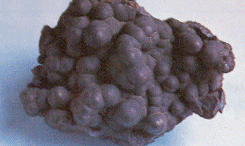
Re: Check this out, Martian NOT !!

Re: Check this out, Martian NOT !!

Mon May 10 21:32:15 EDT 2004

On May 10, 2004, Steven Drummond wrote:


>Hi, Check this out , Something this size weighing

>3 kilos, Must be from a neutron star . Certainly not

>a meteorite. I thought the list members would like to


>see this one .

http://cgi.ebay.com/ws/eBayISAPI.dll?ViewItem&category=415&item=2243979041&rd=1

>Good for a laugh anyway.


This is a nice example of botryoidal goethite or
hematite. :-)

Go look at 1. " Botryoidal hematite has the appearance
of grape clusters" in

http://www.csun.edu/geology/Class_Notes/ES300/300hematite.html
http://www.csun.edu/geology/Class_Notes/ES300/300hematitebotryoidal.jpg

2. "Hematite An excellent thumbnail floater
of botryoidal (almost oolitic in size)..." in
"Mineral Collection Images - My Mineral Collection,
Miscellaneous Systematic Oxides Page" at:

http://www-2.cs.cmu.edu/~adg/images/minerals/o/hematite_b.jpg
http://www-2.cs.cmu.edu/~adg/adg-psoimages.html

3. "Hematite, - botryoidal, Compton Martin" In
"minerals of England and Wales" at:

http://www.webstrategy.freeserve.co.uk/mineral/S-G.htm
http://www.webstrategy.freeserve.co.uk/mineral/picbu/Hematite.jpg
http://mwoolley.customer.netspace.net.au/M-botryoidal.gif

and

4. "Botryoidal Hematite" in "Various Crystals 1" at:

http://uk.geocities.com/magoos_universe/BotHem.jpg
http://uk.geocities.com/magoos_universe/cry_mis1.htm

Yours,

Paul
Baton Rouge, LA

Friday, 30 April 2004

Question About Elbert A. King Research

Question About Elbert A. King Research

Fri Apr 30 16:40:59 EDT 2004

As a geologist involved in studying an impact crater
in Louisiana, i.e. Heinrich (2002, 2003), I have been
trying to track down research notes and specimens
used by Dr. Elbert A. King for specific research of
his that was published when he was at University of
Houston, Texas. Does anyone know either where his
research notes and specimens were archived or whom I
might contact about them?

Do you know how I might contact his daughter, Lisa
King, by snail mail?

Please, reply off list.

References Cited:

Heinrich, Paul V. (2002) Possible meteorite impact
crater in St. Helena Parish, Louisiana. Louisiana
Geological Survey News. vol. 13, pp. 3-5.

Heinrich, P. V. (2003) Origin of a Circular
Depression and Associated Fractured and Shocked
Quartz, St. Helena Parish, LA. Transactions of
the Gulf Coast Association of Geological Societies.
vol. 53, pp. 313-322.

An online version of Heinrich (2002) can be found at;
http://www.searchanddiscovery.com/documents/2003/heinrich/index.htm
http://www.searchanddiscovery.com/documents/2003/heinrich/images/heinrich.pdf

The abstract to Heinrich (2003) can be found at:
http://www.searchanddiscovery.com/documents/abstracts/gcags2003/heinrich.pdf

Best Regards;

P. V. Heinrich
Baton Rouge, LA 70803

Wednesday, 25 February 2004

Landmark’s fame had meteoric rise (Meteor Crater Article)

Landmark’s fame had meteoric rise (Meteor Crater Article)

Paul H bristolia at yahoo.com
Fri Dec 24 21:52:54 EST 2004

Landmark’s fame had meteoric rise
By Paul Giblin, East Valley Tribune, Dec. 24, 2004
http://www.eastvalleytribune.com/index.php?sty=32644

"METEOR CRATER - Philadelphia mining engineer Daniel
Moreau Barringer heard about a deep circular hole in
northern Arizona one day in 1902. That bit of
information
marked the start of one of the most bizarre adventures

in Arizona history."

Friday, 4 July 2003

New Libyan Desert Glass Paper

New Libyan Desert Glass Paper

Paul
Thu, 03 Jul 2003 06:37:28 -0700

Along with the paper on Darwin Glass, I also found
a new Libyan Desert Glass abstract,while looking
for some stuff.

The paper is:

Koeberl, C., Rampino, M. R., Jalufka, D. A.,
and Winiarski, D. H.,2003, A 2003 Expedition
into the Libyan Desert Glass Strewn field,
Great Sand Sea,Western Egypt. Third International
Conference on Large Meteorite Impacts, August 5-7,
2003, Klosterle, Nordlingen,Germany.

It can be downloaded from:

http://www.lpi.usra.edu/meetings/largeimpacts2003/pdf/4079.pdf

This paper appears in Tuesday, August 5,
2003, POSTER SESSION 5:30 p.m. Gewölbe,
Rathaus (Town Hall

http://www.lpi.usra.edu/meetings/largeimpacts2003/pdf/sess03.pdf.
http://www.lpi.usra.edu/meetings/largeimpacts2003/

Yours,

Paul
Baton Rouge, LA