Including Original "Paul H. Letters" Copyright © 1996-2025 Paul V. Heinrich / website © 1996-2025 Dirk Ross - All rights reserved.


Showing posts with label Impact Crater. Show all posts

Wednesday, 21 September 2022

Meteor Crater, AZ: The impact crater that keeps on giving 21SEP2022

Meteor crater, AZ: The impact crater that keeps on giving

Meteor Crater, AZ: The hole from space that keeps on giving
By Leonard David, SpaceCom, August 25, 2022
https://www.space.com/meteor-crater-hole-from-space-lunar-surface

Research payoffs from the out-of-this-world Meteor Crater are ongoing.

Yours,

Paul H.

Wednesday, 27 December 2017

New clues about Earth’s most elusive impact crater

New clues about Earth’s most elusive impact crater

Cavosie, A.J., N.E. Timms, T.M. Erickson, and C. Koeberl, 2017,
New clues from Earth’s most elusive impact crater: Evidence
of reidite in Australasian tektites from Thailand. Geology
Published: December 20, 2017 DOI: https://doi.org/10.1130/G39711.1
https://pubs.geoscienceworld.org/gsa/geology/article-abstract/525531/new-clues-from-earth-s-most-elusive-impact-crater?

" Here we report new evidence of a rare high-pressure
phase in Australasian tektites that further constrains
the location of the source crater. The former presence
of reidite, a high-pressure polymorph of zircon, was
detected in granular zircon grains within Muong
Nong–type tektites from Thailand."

"The data presented here place further constraints on the
distribution of high-pressure phases in Australasian tektites,
including coesite and now reidite, to an area centered over
Southeast Asia, which appears to be the most likely location
of the source crater."

Yours,

Paul H.

Monday, 7 July 2014

Online Thesis About The Bloody Creek Crater, southwestern Nova Scotia.

Online Thesis About The Bloody Creek Crater, southwestern Nova Scotia

While searching the Internet, I came across tan accessibel
PDF version of a thesis about the the Bloody Creek structure
Nova Scotia, Canada. It is:

Nalepa, M. E. 2012, Investigation of the form and age of
the Bloody Creek Crater, southwestern Nova Scotia.
unpublished Acadia Honour’s thesis, Vaughan Memorial
Library, Acadia University, Wolfville, Nova Scotia, Canada
http://openarchive.acadiau.ca/cdm/ref/collection/HTheses/id/753

Other online versions of publications about the Bloody
Creek structure are:

Anonymous (1995) Meteor Crater, Nova Scotia. The
Journal of the Royal Astronomical Society of Canada.
vol. 89, pp. 111–113.
http://articles.adsabs.harvard.edu//full/1995JRASC..89..110./0000111.000.html
http://articles.adsabs.harvard.edu//full/1995JRASC..89..110./0000110.000.html

Brisco, T. H. (2009) The North Group – A newly
discovered multiple impact crater site in southwestern
Nova Scotia? Atlantic Geology. vol. 45, p. 146
http://ees.acadiau.ca/tl_files/sites/ees/pdfs/AUGC_Abstract_example.pdf

Brisco, T. H., I. P. Spooner, P. Pufahl, E. King, and
G. Stevens (2010) The North Group; a possible multiple
impact crater site in southwestern Nova Scotia. Atlantic
Geology. vl. 46, pp. 44-45
http://www.cspg.org/documents/Conventions/Archives/Annual/2010/0784_GC2010_The_North_Group_Possible_Multiple_Impact_Crater_Site.pdf

Stevens, G., I. Spooner, J. Morrow, P. Pufah, R. Raeside,
R. A. F. Grieve, C. R. Stanley, S. M. Barr, and D.
McMullin (2008) Physical evidence of a late-glacial
(Younger Dryas?) impact event in southwestern Nova
Scotia. Atlantic Geology. vol. 44, p. 42.
http://www.cspg.org/documents/Conventions/Archives/Annual/2010/0784_GC2010_The_North_Group_Possible_Multiple_Impact_Crater_Site.pdf

Spooner I., G. Stevens, J. Morrow, P. Pufahl, R. A. F.
Grieve, R. Raeside, J. Pilon, C. Stanley, S. Barr, and D.
McMullin (2009) Identification of the Bloody Creek
structure, a possible impact crater in southwestern
Nova Scotia, Canada. Meteoritics and Planetary Science.
vol. 44, pp. 1193–1202.
https://journals.uair.arizona.edu/index.php/maps/article/viewFile/15765/15753

Spooner, I., P. Pufahl, T. Brisco, J. Morrow, M. Nalepa,
J. Spray, P. Williams, and G. Stevens (2013). Creek:
A low-angled multiple impact crater site in southwestern
Nova Scotia, Canada. Geological Society of America
Abstracts with Programs. vol. 45, no. 1, p. 73.
https://gsa.confex.com/gsa/2013NE/webprogram/Paper215551.html

Yours,

Paul H.

Wednesday, 25 June 2014

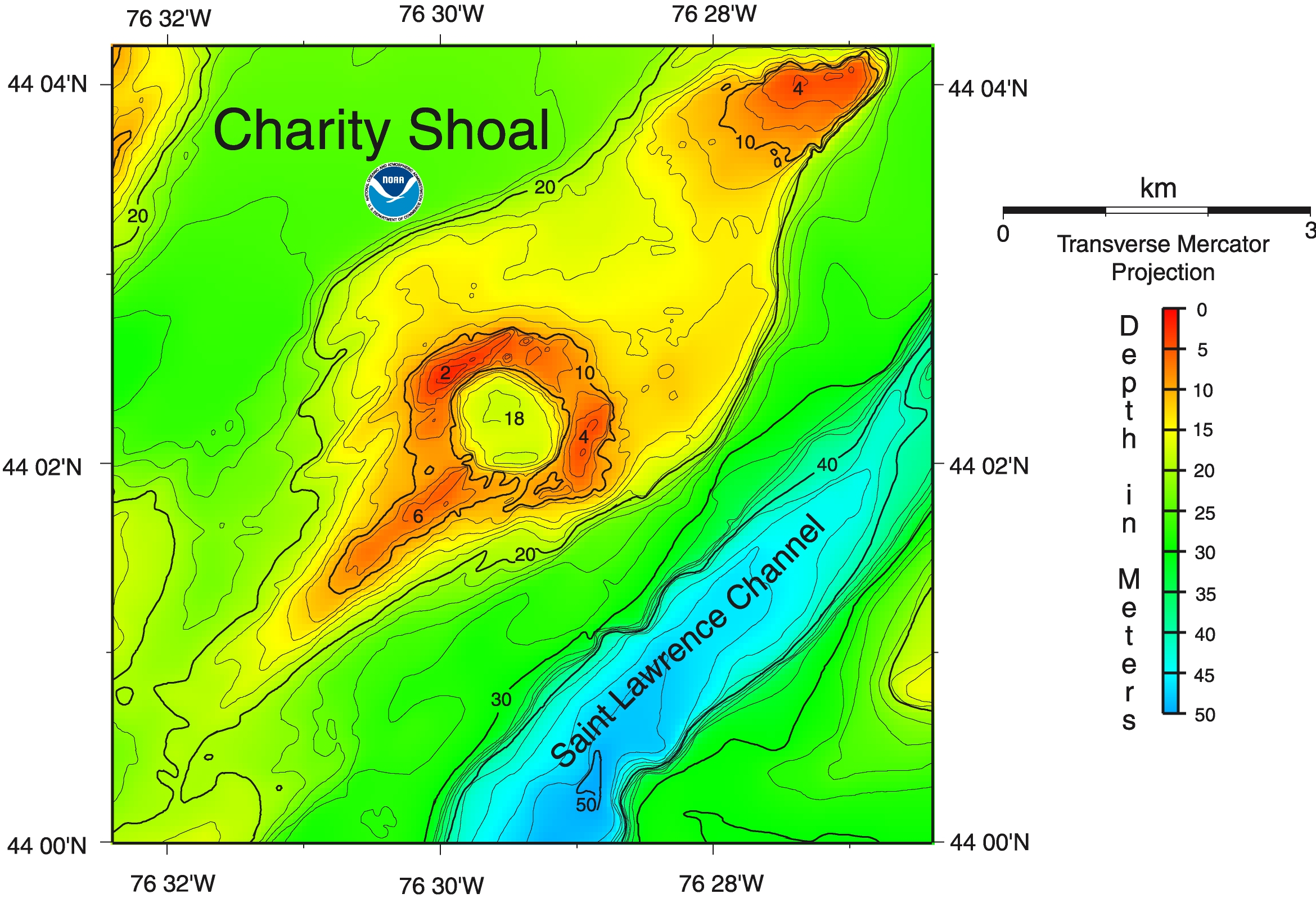
Charity Shoal Crater, an Exhumed Middle Ordovician Impact Crater

Charity Shoal Crater, an Exhumed Middle Ordovician Impact Crater

Holcombe, T. L., S. Youngblut, and N. Slowey, 2013,
Geological structure of Charity Shoal crater, Lake
Ontario, revealed by multi beam bathymetry. Geo-Marine
Letters. col. 33, no. 4, pp 245-252
http://link.springer.com/article/10.1007%2Fs00367-013-0322-6
http://adsabs.harvard.edu/abs/2013GML....33..245H

They argue that the Charity Shoal Crater in Lake
Ontario formed as the result of an extraterrestrial
impact event in a shallow marine environment during
the Middle Ordovician. After the impact, it was
eventually buried by post-impact marine
sedimentation, which covered it with fossiliferous
marine carbonate strata. Much later, they argue,
it was exhumed by Pleistocene glacial erosion.

Other publications are:

Holcombe, T. L., J. S. Warren, D. F. Reid, W. T.
Virden, and D. L. Divins, 2001, Small Rimmed Depression
in Lake Ontario: An Impact Crater? Journal of Great
Lakes Research. vol. 27, no. 4, pp. 510-517
PDF file at http://www.glerl.noaa.gov/pubs/fulltext/2001/20010012.pdf
abstract at https://www.sciencedirect.com/science/journal/03801330/27/4

Phillip, S. A., 2013, High-resolution lake-based
magnetic mapping and modelling of basement structures,
with examples from Küçükçekmece Lagoon, Turkey and
Charity Shoal, Lake Ontario. unpublished MS thesis,
School of Geography and Earth Sciences, McMaster
University, Hamilton, Ontario. 113 pp.
https://macsphere.mcmaster.ca/handle/11375/13532

Bathymetric map of Charity Crater area.

Great Lakes Data Rescue Project - Lake Ontario Bathymetry
https://www.ngdc.noaa.gov/mgg/greatlakes/lakeontario_cdrom/html/area12.htm
https://www.ngdc.noaa.gov/mgg/greatlakes/lakeontario_cdrom/images/a12_lg.jpg

Yours,

Paul H.

Sunday, 15 June 2014

Where have all the craters gone?

Where have all the craters gone?

Where have all the craters gone? Geological Society
of America, ScienceDaily, May 27, 2014
http://www.sciencedaily.com/releases/2014/05/140527154715.htm

The paper is:
Johnson, B. C., and T. J. Bowling, 2014, Where have
all the craters gone? Earth's bombardment history and
the expected terrestrial cratering record. Geology.
First published online May 22, 2014, doi: 10.1130/G35754.1
http://geology.gsapubs.org/content/early/2014/05/21/G35754.1

An older and related article is:
Tiny 'spherules' reveal details about Earth's asteroid
impacts, Purdue University, April 25, 2012
http://www.purdue.edu/newsroom/research/2012/120425MeloshImpacts.html
http://www.sciencedaily.com/releases/2012/04/120425140316.htm

The paper is:
Johnson, B. C., and H. J. Melosh, 2012, Impact
spherules as a record of an ancient heavy bombardment
of Earth. Nature. vol. 485, no. 7396, pp. 75–77.
http://www.nature.com/nature/journal/v485/n7396/full/nature10982.html

Yours,

Paul H.

-----


MikeG wrote:

>(Keep posting the links though - every
>now and then, one of the papers is free)

The abstract for the PDF of the Lunar and Planetary
Science Conference version of Johnson and Bowling
(2014) is at http://www.hou.usra.edu/meetings/lpsc2014/pdf/2414.pdf

Th PDF file of Johnson and Melosh (2012) is at
http://211.144.68.84:9998/91keshi/Public/File/34/485-7396/pdf/nature10982.pdf

Yours,

Paul H.

Tuesday, 25 February 2014

Biggest observed meteorite impact' hits Moon

Biggest observed meteorite impact hits Moon

Biggest observed meteorite impact hits Moon
by Rebecca Morelle, BBC World Service
http://www.bbc.co.uk/news/science-environment-26325934

Meteorite smashes into moon in largest lunar
impact ever recorded, The Guardian
http://www.theguardian.com/science/2014/feb/24/meteorite-moon-largest-lunar-impact-recorded

Astronomers spot record-breaking lunar impact
Phys.Org, February 24, 2104
http://phys.org/news/2014-02-astronomers-record-breaking-lunar-impact.html

Yours,
Paul H.

For All of Paul V. Heinrich's "The e-Pistles of Paul ©2010 A.D."
http://theepistlesofpaul.blogspot.jp/

2014 The Year of "CERTAIN Uncertainty" ™; Meteors, Asteroids, Comets, and MORE!!

Friday, 11 October 2013

Saturday, 16 February 2013

Third Largest Impact Structure Reportedly Found in South Australia

Third Largest Impact Structure Reportedly Found in South Australia

World's third largest asteroid impact zone found in
South Australia by Sunanda Creagh February 15, 2013
http://phys.org/news/2013-02-world-largest-asteroid-impact-zone.html

“An asteroid measuring up to 20km across hit South
Australia up to 360 million years ago and left behind
the one of the largest asteroid impact zones on Earth,
according to new research published today.”

Asteroid impact zone found by Sunanda Creagh,
Science Alert, February 15, 2013
http://www.sciencealert.com.au/news/20131502-24059-2.html+

The paper is:

Glikson, Y. A., I. T. Uysal, J. D. F, Gerald, and E. Saygin,
2013, Geophysical anomalies and quartz microstructures,
Eastern Warburton Basin, North-east South Australia:
Tectonic or impact shock metamorphic origin?
Tectonophysics. Available online 12 January 2013
http://www.sciencedirect.com/science/article/pii/S0040195113000188

In reference to the Chelyabinsk Airburst, there is:

Sonic boom caused by meteorite hurtling above Russian
town at 33,000mph smashes buildings and injures 1,000
people before the space rock crashes into frozen lake,
Mail Online, February 15, 2013,
http://www.dailymail.co.uk/news/article-2279020/Russian-meteorite-Moment-meteorite-exploded-doctors-treat-500-people-injured.html

Yours,

Paul H.

Sunday, 22 July 2012

Display of Impact Crater Art (St. Helena Parish, Louisiana)

Display of Impact Crater Art (St. Helena Parish, Louisiana)

There is an exhibit of impact crater art, the Brushy Creek
Crater series" showing at the St Helena Parish (Louisiana)
Tourism Welcome Center on highway 10 from July 12,
2012 through August 30, 2012.
http://www.facebook.com/media/set/?set=a.411287408908565.82081.183147278389247&type=1

The artist is also selling "Flaming Rock" and "Camouflaged
Crater" T-Shirts based upon her paintings.
http://www.facebook.com/pages/Marshatheartist/183147278389247

Best wishes,

Paul H.

Friday, 16 December 2011

Help with new "Holocene" crater – Additional Note

Help with new "Holocene" crater – Additional Note

In the post Help with new "Holocene" crater, at
http://six.pairlist.net/pipermail/meteorite-list/2011-December/081906.html
the crater, which I discussed is the Corossol crater 
(50°3’N, 66°23’W) just offshore of the Sept Iles 
harbour, Gulf of St Lawrence, Canada. It is described in

Higgins, M.D., Lajeunesse, P., St-Onge, G., Locat, J., 
Duchesne, M., Ortiz, J., Sanfaçon, R., 2011. Bathymetric 
and Petrological Evidence for a Young (Pleistocene?) 
4-km Diameter Impact Crater in the Gulf of Saint 
Lawrence, Canada, 42nd Lunar and Planetary 
Science Conference, Houston, Texas.
http://www.lpi.usra.edu/meetings/lpsc2011/pdf/1504.pdf

Yours,

Paul H.

Help with new "Holocene" crater

Help with new "Holocene" crater

In “Help with new Holocene crater, please” at
http://six.pairlist.net/pipermail/meteorite-list/2011-December/081869.html
Ed asked,

"The following structure has been proposed as a crater from 
the Holocene Start Impacts:

http://www.lpi.usra.edu/meetings/lpsc2011/pdf/1504.pdf

I do not play a geologist on television, nor am I one in real life, 
but if the "floor" of this crater dates from 10,900 BCE, then 
that would be the crater floor, and not infill sediments, and 
thus the impact itself would have had to have been well after 
10,900 BCE?"

The article stated,

"The minimum age was established using data from 
a ~7 metre core taken in the central trough, which 
almost reached the basement, as defined by seismic 
data. Calibrated 14C ages of shells in the sediments can 
be extrapolated to give an estimate of the age of the 
base of the sedimentary sequence of ~12,900 cal BP, 
if no hiatus or older sediments were preserved 
between the base of the core and the bedrock. This is 
taken to be the youngest possible age of the impact."

The "floor" of the crater was not dated to ~12,900 cal BP.
It is estimated age of the oldest sediments that covers the
crater that dates to that period. This age only represents 
the latest period of sedimentation occurred in the area. 
Without addition information, it is entirely possible that 
either older sediments existed and have been eroded; 
there was a period of nondeposition before the accumulation
of the sediments covering it; or a combination of both.
All that can be said is the crater is older than ~12,900 
cal BP and younger than Ordovician. The morphology of 
this crater looks likes it has been significantly modified 
by erosion, which suggests that parts of the crater and 
possibly older sediments have been removed by erosion.

Thie ~12,900 cal BP date corresponds to the point in time
that the deglaciation of this part of Canada occurred. This 
would have been the when the ice sheet that covered and 
scoured this region melted back to expose the bottom of
the Gulf of St. Lawrence this part of the Canada. My 
interpretation of this date is that it represents the point
in time when the Laurentide Ice Sheet melted back 
enough to locally expose the bottom of the Gulf of St. 
Lawrence and first allow sediments to accumulate on the
eroded and scoured surface of this crater. Prior to that
time, it was likely covered and scoured by Laurentide 
Ice Sheet. Thus, this crater likely predates the last 
glacial maximum by a unknown period of time much 
like the Charity Shoals crater. From what I can see, this
is definitely not a “Holocene” crater and certainly 
predates the Younger Dryas by a significant period of 
time.

Best wishes,

Paul H.

Sunday, 24 April 2011

Circle Features Found Using Google Earth

Circle Features Found Using Google Earth

The coordinates for a number of new circular features
found by various people using Google Earth are given in:

In Re: Consolidated Impact Crater Database post #1415796 by "ekafeman " at:
http://bbs.keyhole.com/ubb/ubbthreads.php?ubb=showflat&Number= 1415658

The two of the most interesting are:

1, Zhongcangxiang 2, China at 31°59'39.17"N 85° 9'13.94"E
This is about 18km WSW of Zhongcangxiang feature at
32° 2'40.34"N 85°20'1.97"E) It is about 0.03 km in diameter.
http://bbs.keyhole.com/ubb/ubbthreads.php?ubb=showflat&Number= 572974

Zhongcangxiang 2, like Zhongcangxiang, is a "conspicuous 
simple round depression." It is in a very distinct circular
in what appears to an otherwise featureless alluvial surface
of some sort.

2. Rodillo Beach (?), Chile at 26°58'32.26"S 70°47'27.83"W
Although it is only about 0.02 in diameter. This feature is
much more ambiguous. However, it still interesting. Anyone

Unfortunately, it is impossible to tell what both of these 
features might be from aerial photography alone. It is in
a location where anyone taking in the sun at Rodillo Beach
might be able to visit it.

The other circular features seem much less promising. Still,
it is interesting to see what sort of features people are finding
using Google Earth.

Best wishes,

Paul H.

Wednesday, 10 March 2010

Jungle-Covered Impact Crater in Columbia (Vichada crater) Tuesday, March 9, 2010

Jungle-Covered Impact Crater in Columbia (Vichada crater)

Tuesday, March 9, 2010 10:42 PM

Jungle-Covered Impact Crater by R. Martin, February 27, 2010

http://scienceblogs.com/aardvarchaeology/2010/02/jungle-covered_impact_crater.php


Planetary Society Researcher Max Rocca Discovers Largest
Impact Crater in South America: A Target Earth update by Amir
Alexander, The Planetary Society

http://www.planetary.org/programs/projects/targetearth/20100213.html


Yours,

Paul H.

Tuesday, 23 February 2010

The Convincing Identification of Terrestrial Meteorite Impact Strutures

The Convincing Identification of Terrestrial Meteorite Impact Strutures

Paul Heinrich oxytropidoceras at cox.net
Tue Feb 23 23:19:36 EST 2010

French, B. M., and C. Koeberl, 2010, The convincing
identification of terrestrial meteorite impact structures:
What works, what doesn't, and why. Earth-Science
Reviews. vol. 98, no. 1-2, pp. 123-170.

Abstract at:

http://dx.doi.org/10.1016/j.earscirev.2009.10.009
http://www.sciencedirect.com/science?_ob=PublicationURL&_tockey=%23TOC%235802%232010%23999019998%231570149%23FLA%23&_cdi=5802&_pubType=J&view=c&_auth=y&_acct=C000050221&_version=1&_urlVersion=0&_userid=10&md5=2e423780e17d5ed60d7ca17a1faf9e9b

The PDF file for this paper and issue is open access
and can be freely downloaded.

Yours,

Paul H.

Wednesday, 5 August 2009

Free PDF File of Paper About Proposed Wilkes Land, Antarctica, Impact Crater

Free PDF File of Paper About Proposed Wilkes Land, Antarctica, Impact Crater

Paul bristolia at yahoo.com
Wed Aug 5 08:34:19 EDT 2009

Dear friends,

In a previous message I wrote:

"I came across a new paper about the proposed 300 km
in diameter impact crater in Wilkes Land, Antarctica. It is:

von Frese, R. R. B., L. V. Potts, S. B. Wells, T. E. Leftwich, H. R. Kim, J. W.
Kim, A. V. Golynsky, O. Hernandez, and L. R. Gaya-Piqué (2009), GRACE
gravity evidence for an impact basin in Wilkes Land, Antarctica, Geochemistry
Geophysics Geosystems, 10, Q02014, doi:10.1029/2008GC002149.

http://www.agu.org/pubs/crossref/2009/2008GC002149.shtml "

While doing additional googling, I came across an URL where the PDF
file for this paper can be found. The PDF file for this paper can be
downloaded for free from:

http://www.geology.osu.edu/~vonfrese/general/WLIB_gcubed09.pdf

Yours,

Paul H.

Monday, 18 August 2008

Meteorite impact structures: the good and the bad

Meteorite impact structures: the good and the bad

Paul bristolia at yahoo.com
Mon Aug 18 09:15:01 EDT 2008

While looking for something else I came across a general article
about impact structures. It is:

Osinsk, G. R., 1999, Meteorite impact structures: the good and
the bad. Geology Today. vol. 24, no. 1, pp. 13-19.

The PDF file is at:

http://www3.interscience.wiley.com/cgi-bin/fulltext/119400823/PDFSTART

The abstract is at:

http://www3.interscience.wiley.com/journal/119400823/abstract

Yours,

Paul H.

Wednesday, 31 October 2007

Wednesday, 17 October 2007

Article About the Hico (Impact ????) Structure (Texas)

Article About the Hico (Impact ????) Structure (Texas)

Paul bristolia at yahoo.com
Wed Oct 17 14:10:30 EDT 2007

There is a short article about the Hico Structure in
Erath-Hamilton counties Texas, which has been argued
to be an impact structure in the November 2007 issue
of the Houston Gem and Mineral Society’s newsletter,
the Backbender's Gazette.

The Mysterious Hico Structure, Hamilton-Erath
Counties, Texas. BackBender's Gazette. vol. XXXVIII,
no. 11, pp. 11-16 (November 2007)

This issue can be downloaded from either

http://www.hgms.org/Backbender%27sGazetteIssues.html

or http://www.hgms.org/BBG/Nov07.pdf .

Yours,

Paul

Friday, 21 September 2007

Experts Skeptical of Peruvian Meteorite Impact

Experts Skeptical of Peruvian Meteorite Impact

Paul bristolia at yahoo.com
Thu Sep 20 17:06:51 EDT 2007

Scientists Doubt Meteorite Sickened Peruvians by
By Andrea Thompson, Space.com, September 19, 2007

http://www.space.com/scienceastronomy/070919_peru_meteorite.html

Experts: 'Meteor' Gases Likely Caused by Geyser,
Fox News September 19, 2007

http://www.foxnews.com/story/0,2933,297369,00.html

The only saving grace about this story is the last line, which reads:

"Peruvian geologists are on their way to examine the crater, according to news reports."

Hopefully, this means someone will get down to the bottom of this mess and determine what really happened.

These stories have been followed by:

Peruvian Geophysicist Confirms Claim of Meteorite Crash
By Monte Hayes, Associated Press, September. 19, 2007

http://www.space.com/scienceastronomy/070919_ap_meteorite_peru.html

It stated:

"Jose Mechare, a scientist with Peru's Geological, Mining and Metallurgical Institute, said a geologist had confirmed that it was a "rocky meteorite,'' based on the fragments analyzed."

The sickness was explained by this line in the article:

"He said fear may have provoked psychosomatic ailments."

They article finally stated:

"She said that after the meteorite struck, small rocks
rained down on the roof of her house for several minutes and she feared the house was going to collapse."

Best Regards,

Paul

Thursday, 30 August 2007

New Analysis Of Odessa Crater Impact Published

New Analysis Of Odessa Crater Impact Published

Paul bristolia at yahoo.com
Thu Aug 30 12:48:22 EDT 2007

Dear Friends,

A paper, which present a detailed analysis of the Odessa crater, Texas
has been published in the journal of “International Journal of Impact
Engineering”. The paper is:

Littlefield, D. L., P. T. Bauman, and A. Molineuxc, 2007, Analysis
of formation of the Odessa crater. International Journal of Impact
Engineering. vol. 34, no. 12, pp. 1953–1961.

http://www.sciencedirect.com/science?_ob=ArticleURL&_udi=B6V3K-4MS9RDR-1&_user=3787556&_coverDate=12%2F31%2F2007&_rdoc=1&_fmt=&_orig=search&_sort=d&view=c&_acct=C000061383&_version=1&_urlVersion=0&_userid=3787556&md5=ea5c24c5520861f070d6d17e841771ac

In an hydrodynamics codes analysis, which integrated the geotechnical
(mechanical) properties of the target material along with details of the
topology of the crater, this study concluded:

1. The crater resulted from a near-grazing impact at very high obliquity,
likely greater than 60 degrees;

2. The depth-to-diameter ratio of the Odessa crater “is in a range
that can be reproduced only with a high-obliquity impact";

3. The meteorite likely came from either the southwest or northeast;

4. meteorite impact energy was more than 50 times larger than
originally estimated.

and 5. the meteor diameter was much larger than 2 meters.

Yours,

Paul H.