Including Original "Paul H. Letters" Copyright © 1996-2025 Paul V. Heinrich / website © 1996-2025 Dirk Ross - All rights reserved.


Monday, 24 March 2008

Shocked Quartz Found at Upheaval Dome, Utah

Shocked Quartz Found at Upheaval Dome, Utah

Paul bristolia at yahoo.com
Mon Mar 24 12:35:10 EDT 2008

Buchner, E., and T. Kenkmann, 2008, Upheaval Dome, Utah, USA:
Impact origin confirmed. Geology. vol.36, no. 3, pp. 227-230.

In part, this abstract stated:

“In this study, we document, for the first time, shocked
quartz grains from this crater in sandstones of the
Jurassic Kayenta Formation. The investigated grains
contain multiple sets of decorated planar deformation
features. ... The shocked quartz grains were found in
the periphery of the central uplift in the northeastern
sector of the crater, which most likely represents the
cross range crater sector.”

http://www.gsajournals.org/perlserv/?request=get-abstract&doi=10.1130%2FG24287A.1

Yours,

Paul H.

Precambrian impact ejecta blanket found in Scotland

Precambrian impact ejecta blanket found in Scotland

Paul bristolia at yahoo.com
Mon Mar 24 12:09:42 EDT 2008

Amor, K., Stephen P.Hesselbo, Don Porcelli, Scott Thackrey, and
John Parnell, 2008, A Precambrian proximal ejecta blanket from
Scotland. Geology..vol. 36, no. 4, pp. 303-306.

In part theabstract reads:

“The StacFada Member of the Precambrian Stoer Group in Scotland
haspreviously been described as volcanic in origin. However,
shockedquartz and biotite provide evidence for high-pressure shock
metamorphism, while chromium isotopevalues and elevated
abundancesof platinum group metals and siderophile elements
indicateaddition of meteoritic material. Thus, the unit is
reinterpretedhere as having an impact origin.”

This unit isas much as 20 meters thick in places.

http://www.gsajournals.org/perlserv/?request=get-abstract&doi=10.1130%2FG24454A.1


Related paper:


Young, G. M., 2002, Stratigraphy and geochemistry of volcanic
mass flows in the Stac Fada Member of the Stoer Group,
Torridonian, NW Scotland. Royal Society of Edinburgh Transactions:
Earth Sciences. vol. 93, no. 1, pp. 1-16.


Yours,

Paul H.

Australasian strewn field extended to Antarctica

Australasian strewn field extended to Antarctica

Paul bristolia at yahoo.com
Mon Mar 24 11:59:10 EDT 2008

Folco, L., P.
Rochette, N. Perchiazzi, M. D'Orazio, M.A. Laurenzi, and M.
Tiepolo, 2008, Microtektites
from Victoria Land Transantarctic Mountains.
Geology. vol.36, no. 4, pp. 291-294.

They documented a
microtektite (microscopic impact glass particles)
strewn field in the Victoria LandTransantarctic Mountains, Antarctica.
They found "the physical and chemicalproperties define a coherent
population with a geochemical affinity to Australasianmicrotektites
and compatible Quaternary 40Ar-39Ar formation age." They argue
"that
Transantarctic Mountain microtektites (TAMM) define the
southern extension of theAustralasian strewn field."

http://www.gsajournals.org/perlserv/?request=get-abstract&doi=10.1130%2FG24528A.1

Yours,

Paul H.

Friday, 21 March 2008

Earth, Mars, Moon Have Different Origin, Study Says

Earth, Mars, Moon Have Different Origin, Study Says

Paul bristolia at yahoo.com
Fri Mar 21 14:08:37 EDT 2008

Earth, Mars, Moon Have Different Origin, Study Says
by Anne Minard, National Geographic News, March 19, 2008

http://news.nationalgeographic.com/news/2008/03/080319-earth-mars.html

Yours,

Paul H.

Thursday, 13 March 2008

Meteorite fragment stolen from museum

Meteorite fragment stolen from museum

Paul bristolia at yahoo.com
Thu Mar 13 11:00:39 EDT 2008

Meteorite fragment stolen from museum
Associated Press, March 13, 2008
http://www.indystar.com/apps/pbcs.dll/article?AID=/20080313/LOCAL/80313031


Museum may upgrade security after meteorite slice is stolen
WLFI.com, IN, March 13, 2008
http://www.wlfi.com/Global/story.asp?S=8008964&nav=menu591_3


Yours,


Paul H.

Thursday, 17 January 2008

Asteroid Impacts May Have Triggered Plate Tectonics

Asteroid Impacts May Have Triggered Plate Tectonics

Paul bristolia at yahoo.com
Wed Jan 16 13:05:19 EST 2008

Meteor Pelting May Have Triggered Plate Tectonics
Larry O'Hanlon, Discovery News

http://dsc.discovery.com/news/2007/12/10/meteors-earth.html
http://dsc.discovery.com/news/2007/12/10/meteors-earth-print.html

Hansen , V. L., 2007, Subduction origin on early Earth: A hypothesis.
Geology. vol. 35, no. 12, pp. 1059–1062

http://www.gsajournals.org/perlserv/?request=get-abstract&doi=10.1130%2FG24202A.1

Yours,

Paul H.

Tuesday, 8 January 2008

Article About Firestone’s Hypotheses Published in “GSA Today”

Article About Firestone’s Hypotheses Published in “GSA Today”

Paul bristolia at yahoo.com
Mon Jan 7 17:02:13 EST 2008

An article, which includes comments about Firestone’s terminal
Pleistocene impact and other hypotheses has been published in
“GSA Today”. It is:

Pinter, N., and S.E. Ishman, 2008, Impacts, mega-tsunami, and
other extraordinary claims. GSA Today. vol. 18, no. 1, pp. 37-38.

This article can be downloaded from:

http://www.gsajournals.org/archive/1052-5173/18/1/pdf/i1052-5173-18-1-37.p

and

http://www.gsajournals.org/perlserv/?request=get-document&doi=10.1130%2FGSAT01801GW.1

linked at:

http://www.gsajournals.org/perlserv/?request=index-html&issn=1052-5173

Yours,

Paul H.

Saturday, 5 January 2008

Asteroid Impacts May Have Boosted Evolution

Asteroid Impacts May Have Boosted Evolution

Paul bristolia at yahoo.com
Fri Jan 4 09:57:19 EST 2008

Asteroid Impacts May Have Boosted Evolution By Dave Mosher
December 18, 2007

http://www.foxnews.com/story/0,2933,317375,00.html

The article stated in part:

“Space rocks are blamed for a lot of rough times on Earth,
from the die-off of most marine animals some 250 million
years ago to the disappearance of the dinosaurs 65 million
years in the past.

A new theory, however, suggests that catastrophic meteorite
impacts are linked to an explosion in biodiversity about 470
million years ago, during the Ordovician Period.”

Yours,

Paul H


Saturday, 22 December 2007

Coal Methane Contributed Late Permian Extinctions ????

Coal Methane Contributed Late Permian Extinctions ????

Paul bristolia at yahoo.com
Fri Dec 21 16:23:22 EST 2007

Dear friends,

There is an interesting paper about how coal methane
might have contributed to Late Permian extinctions.

It is:

Retallack, G. J., and A. H. Jahren. 2007, Methane Release
from Igneous Intrusion of Coal during Late Permian
Extinction Events. The Journal of Geology. vol. 116, pp. 1–20

http://www.journals.uchicago.edu/doi/abs/10.1086/524120

In part the abstract read:

“Unusually large and locally variable carbon isotope excursions
coincident with mass extinctions at the end of the Permian
Period (253 Ma) and Guadalupian Epoch (260 Ma) can be
attributed to methane outbursts to the atmosphere. .... On
paleogeographic maps, the most marked carbon isotope
excursions form linear arrays back to plausible methane
sources: end-Permian Siberian Traps and Longwood-Bluff
intrusions of New Zealand and end-Guadalupian Emeishan
Traps of China. Intrusion of coal seams by feeder dikes to
flood basalts could create successive thermogenic methane
outbursts of the observed timing and magnitude, ...
Methane released by fracturing and heating of coal during
intrusion of large igneous provinces may have been a
planetary hazard comparable with bolide impact.”

This paper concluded:

“Addition of the end-Guadalupian case to the better known
end-Permian, end-Triassic, and end-Cretaceous cases
makes coincidence less likely, and copious generation of
methane by intrusion of coals supplies ample killing power.
Like meteorite and comet impacts, thermogenic methane
outbursts may have been significant hazards to life on Earth.”

Yours,

Paul H.

Friday, 14 December 2007

Meteorite articles in "Comptes Rendus Geosciences"

Meteorite articles in "Comptes Rendus Geosciences"

Paul bristolia at yahoo.com
Thu Dec 13 09:26:18 EST 2007

Volume 339, No. 14-15 (November 2007), issue of Comptes
Rendus Geosciences has a few articles about "Formation
du système solaire : approche cosmochimique dans le c
onteste astrophysique. They include:

1. Short-lived radioactive nuclides in meteorites and early
solar system processes by Marc Chaussidon and Matthieu
Gounelle.

2. The insoluble organic matter in carbonaceous chondrites:
Chemical structure, isotopic composition and origin by
Laurent Remusat, François Robert and Sylvie Derenne

and 3. Impacts in the primordial history of terrestrial planets
by Alessandro Morbidelli

Yours,

Paul H.

Arctic Impact Crater Lake Reveals Interglacial Climate

Arctic Impact Crater Lake Reveals Interglacial Climate

Paul bristolia at yahoo.com
Thu Dec 13 09:21:21 EST 2007

Arctic Impact Crater Lake Reveals Interglacial
Cycles in Sediments Univerity of Arkansas,
December 11, 2007

http://dailyheadlines.uark.edu/11974.htm

Pingualuit Crater Lake Project

http://www.cen.ulaval.ca/pingualuit/index.html

Yours

Paul H.

Thursday, 13 December 2007

Evidence Against Permian-Triassic Asteroid Impact Published

Evidence Against Permian-Triassic Asteroid Impact Published

Paul bristolia at yahoo.com
Wed Dec 12 16:21:26 EST 2007

In “December Media Highlights: Geology and GSA Today” at:
http://www.geosociety.org/news/pr/07-68.htm, there is:

Xie, S., R. D. Pancost, J. Huang, P. B. Wignall, J.
Yu, X. Tang, L. Chen, X. Huang, and X. Lai, 2007,
Changes in the global carbon cycle occurred as two
episodes during the Permian-Triassic crisis. Vol. 35,
no. 12, pp. 1083-1086.

http://www.gsajournals.org/perlserv/?request=get-abstract&doi=10.1130%2FG24224A.1

The press release stated:

“Earth witnessed its most severe mass extinction 250
million years ago. This extinction has been thought
to be abrupt and probably caused by an extraterrestrial
impact. However, Xie et al. present several lines of
geochemical evidence from a South China section (an
optimal section to study the biotic crisis) that
indicates a two-episodic global change in association
with the ecological crisis. The global carbon cycle,
the enhanced terrestrial weathering, the marine
photic zone euxinia, the faunal mass extinction,
and the cyanobacterial expansion all occurred as two
episodes, showing a close coupling among the ocean,
the atmosphere, and the land system at that time. In
particular, Xie et al. found that the first episode
occurred before the presumed bolide impact. The
temporal sequence of these two events suggests that
the biotic crisis was a consequence of prolonged and
episodic changes in the marine and continental
systems, and argues against an extraterrestrial
impact as the main cause.”

Yours,

Paul H.

Crow Creek Member of Pierre Shale is Impact Tsunami Generated

Crow Creek Member of Pierre Shale is Impact Tsunami Generated

Paul bristolia at yahoo.com
Wed Dec 12 16:19:38 EST 2007

In “December Media Highlights: Geology and GSA Today” at:
http://www.geosociety.org/news/pr/07-68.htm , there is:

Weber, R. D., and D. K. Watkins, 2007, Evidence from
the Crow Creek Member (Pierre Shale) for an impact-
induced resuspension event in the late Cretaceous
Western Interior Seaway. . Vol. 35, no. 12,
pp. 1119-1122.

http://www.gsajournals.org/perlserv/?request=get-abstract&doi=10.1130%2FG24209A.1

The press release stated:

The Crow Creek Member, a unique rock unit in the Upper
Cretaceous Pierre Shale in South Dakota and Nebraska,
has been thought to represent sea-level rise along
the eastern margin of the Western Interior Seaway.
However, Weber et al. show that the presence of impact
ejecta from the Manson Impact Structure, found within
the Member, suggests an impact-induced genesis.
Current investigation of a reworked nannofossil
assemblage occurring within the Crow Creek Member is
consistent with an origin involving gravitational
settling rather than sea-level rise. Additionally,
the reworked assemblage decreases in abundance with
increased distances from the Manson Impact Structure.
These observations support the hypothesis that Manson
Impact may have caused a re-suspension event in the
Western Interior Seaway, resulting in Crow Creek
deposition.”

Yours,

Paul H.

AGU Paper Claims Meteorites Blasted Mammoths

AGU Paper Claims Meteorites Blasted Mammoths

Paul bristolia at yahoo.com
Wed Dec 12 09:56:40 EST 2007

Great beasts peppered from space
By Jonathan Amos, BBC News

http://news.bbc.co.uk/1/hi/sci/tech/7130014.stm

“Startling evidence has been found which shows
mammoth and other great beasts from the last
ice age were blasted with material that came
from space.”

+++++

Mammoth tusks show up meteorite shower: Fossils
could provide a new gold mine for micrometeorite
hunters by Rex Dalton, Nature News

http://www.nature.com/news/2007/071212/full/news.2007.372.html

+++++

Proof great beasts were blasted from space By
Laura Clout, T he Telegraph, Decemebr 12, 2007

http://www.telegraph.co.uk/earth/main.jhtml?view=DETAILS&grid=&xml=/earth/2007/12/12/scidino212.xml

Yours,

Paul

Wednesday, 28 November 2007

Meteorite Shale

Meteorite Shale

Paul bristolia at yahoo.com
Wed Nov 28 13:11:20 EST 2007

Ron asked:


>I see some Meteorites for sale, especially the

>Willamette Meteorite, listed as Meteorite Shale.

>What exactly is Meteorite Shale?


It is a term used for a highly weathered (terrestrialized) meteorite.
The use of “shale”, I suspect, came from the tendency of some
highly weathered meteorites, specifically highly oxidized iron
meteorites to develope a layered structure as they weather and
break into subparallel / parallel layers like shale when broken.

The terms “shale balls” and “iron shale” is also used for
some highly weathered meteorites.

When Meteorites Get Old
http://www.meteorite-times.com/Back_Links/2005/January/Meteorite_of_Month.htm

Yours,

Paul H.

Wednesday, 21 November 2007

Another Possible crater? - Additional Note

Another Possible crater? - Additional Note

Paul bristolia at yahoo.com
Wed Nov 21 09:12:04 EST 2007

This is an additional note to:

http://six.pairlist.net/pipermail/meteorite-list/2007-November/040163.html

In http://six.pairlist.net/pipermail/meteorite-list/2007-November/039955.html
Jerry wrote:

"This is copied from the article that you supplied
herein:

"We will defiantly let you know the outcome of the
research," they said.

Seems there's been quite of few of those threats on
the List this year. Maybe things will calm down to
normal next year and folks will get back to just
nicely reporting the facts."

http://www.havredailynews.com/articles/2007/06/11/local_headlines/local.txt "

A detailed geologic map and description of the
geology of the region of the "Bender Crater"
can be found in:

Knechtel, M. M., 1959, Stratigraphy of the Little Rocky
Mountains and encircling foothills, Montana. United
States Geological Survey Bulletin no. 1072-N, pp.
723-752.

This publication and map can be downloaded from:

http://pubs.er.usgs.gov/usgspubs/b/b1072N

http://onlinepubs.er.usgs.gov/djvu/B/bull_1072_n.djvu

http://onlinepubs.er.usgs.gov/djvu/B/bull_1072_n_plt.djvu

Yours,

Paul H.

Tuesday, 20 November 2007

Another Possible crater?

Another Possible crater?

Paul bristolia at yahoo.com
Tue Nov 20 23:08:04 EST 2007

Jerry wrote:

"This is copied from the article that you supplied
herein:

"We will defiantly let you know the outcome of the
research," they said.

Seems there's been quite of few of those threats on
the List this year. Maybe things will calm down to
normal next year and folks will get back to just
nicely reporting the facts.”

http://www.havredailynews.com/articles/2007/06/11/local_headlines/local.txt "

The origin of these features was discussed back in
June. There are some really nice geological maps,
which show this feature to be a domal uplift, which is
only one of a number of laccoliths and other igneous
intrusions. It is just one of several circular features
of igneous origin that occur locally.

Go look at

http://six.pairlist.net/pipermail/meteorite-list/2007-June/035664.html

There I stated:

"Using information given in the article, I used Google
Earth to find the the location of the structure, which
it discusses. The latitude and longitude of this
structure is:

108.6729941879148 W

47.82294379843308 N

It is on the edge of hills known as "The Little Rocky
Mountains". There a number of circular structure
within the region associated with laccolithic intrusions.

There is a discussion of this in "Geology and Physiography
of Fort Belknap" at:

http://serc.carleton.edu/research_education/nativelands/ftbelknap/geology.html

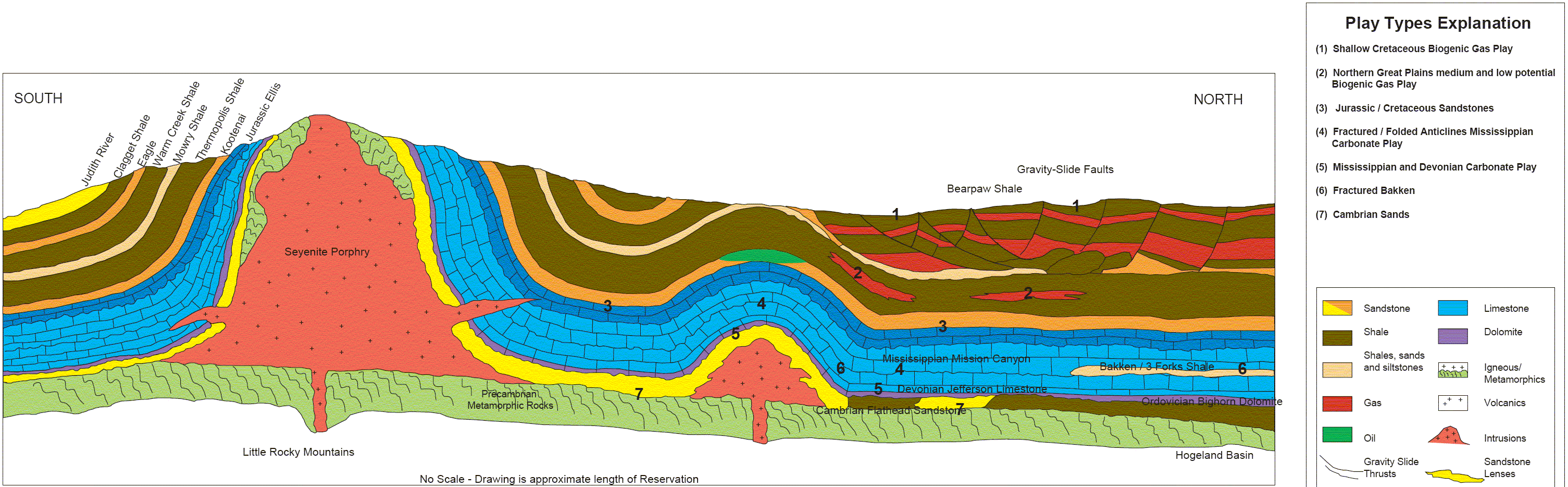
http://serc.carleton.edu/images/research_education/nativelands/ftbelknap/crosssection.gif

The "Geologic Map of the Zortman 30' x 60' Quadrangle,
Central Montana" can be downloaded from:

http://www.mbmg.mtech.edu/stmap.htm

and http://www.mbmg.mtech.edu/pdf_100k/zortman.pdf

Two publications on the geology of the area are:
Knechtel, M.M., 1944, Oil and gas possibilities of the
plains adjacent to the Little Rocky Mountains, Montana:
U.S. Geological Survey, Oil and Gas Investigations
Map OM-4, scale 1:48000.

Knechtel, M.M., 1959, Stratigraphy of the Little Rocky
Mountains and encircling foothills, Montana: U.S.
Geological Survey, Bulletin 1072-N, scale 1:48000.”

Best Regards,

Paul

Monday, 12 November 2007

Rosetta gravity assist flyby

Rosetta gravity assist flyby

Paul bristolia at yahoo.com
Mon Nov 12 16:18:54 EST 2007

Sterling K. Webb wrote:


>There's something re-assuring about the notion

>that we could detect a "potential impactor,"

>even if we didn't immediately recognize that

>it's one of ours!


There is a discussion, which expresses similar
thoughts, of Rosetta, AKA "2007 VN84", in:

That's no near-Earth object, it's a spaceship
By Emily Lakdawalla, Nov. 9, 2007, http://www.planetary.org/blog/article/00001227/

Yours,

Paul H.

Friday, 9 November 2007

Post-Cretaceous/Tertiary Impact Ammonites Found in New Jersey

Post-Cretaceous/Tertiary Impact Ammonites Found in New Jersey

Paul bristolia at yahoo.com
Fri Nov 9 08:48:45 EST 2007

Rethinking What Caused the Last Mass Extinction
by John Noble Wilford, November 6, 2007, New
York Times.

http://www.nytimes.com/2007/11/06/science/06fossil.html?ref=science

http://www.nytimes.com/2007/11/06/science/06fossil.html?pagewanted=1&ei=5070&en=4d31bafcd36b6bfb&ex=1195016400&emc=eta1

“On previous visits, they had found in the Pinna
rock and soil a surprising number of marine fossils,
including small clams, crabs and sea urchins. There
was an abundance of ammonites, considered index
organisms of the uppermost Cretaceous
environment. Somehow, here at least, life appeared
to have not only persisted but also flourished for
tens, perhaps hundreds, of years after the putative
asteroid impact.”

Yours,

Paul H.

Tuesday, 6 November 2007

Question about Polarizing Microscope Lomo Polam P-211

Question about Polarizing Microscope Lomo Polam P-211

Paul bristolia at yahoo.com
Tue Nov 6 14:31:15 EST 2007

On Novemeber 5, 2007 and in "Question about Polarizing
Microscope Lomo Polam P-211", Pat Brown asked:

“Can any of you help me learn anything more about
this microscope? I contacted the good folks at Lomo
USA and they tell me that this microscope was never
supported in the US market and that they can offer
no help or support. I am appealing to the international
members of this list for any help they might be able
to offer.”

A good place to ask this question is the Yahoo Microscope
Group at:

http://tech.groups.yahoo.com/group/Microscope/

There are 2300 members in this group, many of whom
are experts at obtaining second- and third-hand manuals
and parts of microscopes. Also, there is a lot expertise
on this list with petrographic / polarizing microscopes.

Best Regards,

Paul H.