Take a Breath and Thank a Sponge
Take a Breath and Thank a Sponge by Carl Zimmer,
New York Times, March 13, 2014
http://www.nytimes.com/2014/03/18/science/take-a-breath-and-thank-a-sponge.html?_r=1
First animals oxygenated Earth's oceans, study
suggests. ScienceDaily, March 9, 2014
http://www.sciencedaily.com/releases/2014/03/140309150540.htm
The paper is:
Lenton, T. M., R. A. Boyle, S. W. Poulton, G. A. Shields-Zhou,
and N. J. Butterfield, 2014, Co-evolution of eukaryotes and
ocean oxygenation in the Neoproterozoic era. Nature Geoscience.
(advance online publication)
http://www.nature.com/ngeo/journal/vaop/ncurrent/full/ngeo2108.html
A related article is:
Theory on origin of animals challenged: Some animals
need extremely little oxygen, ScienceDaily, February 17, 2014
http://www.sciencedaily.com/releases/2014/02/140217161110.htm
The paper is:
Mills, D. B., L. M. Ward, C.A. Jones, B. Sweeten, M. Forth,
A. H. Treusch and D. E. Canfield. The oxygen requirements
of the earliest animals. Proceedings of the National Academy
of Sciences. Early Edition, February 17, 2014
http://www.pnas.org/content/early/2014/02/13/1400547111.abstract
Paul H.

Sunday, 16 March 2014
Saturday, 15 March 2014
You Can Help Map the Moon by Counting Craters
You Can Help Map the Moon by Counting Craters
CU-Boulder-led study on lunar crater counting
shows crowdsourcing effective, accurate tool.
Be Boulder, university of Boulder, Colorado.
http://www.colorado.edu/news/releases/2014/03/13/cu-boulder-led-study-lunar-crater-counting-shows-crowdsourcing-effective
Counting Craters: YOU Can Help Map the Moon
by Nicole Gugliucci, Discovery.com News,
http://news.discovery.com/space/astronomy/counting-craters-you-can-help-map-the-moon-140314.htm
CosmoQuest’s “MoonMappers” Shows Everyday
People Can Map the Moon, Cosmoquest X Blog,
http://cosmoquest.org/x/press-releases/press-release-cosmoquests-moonmappers-shows-everyday-people-can-map-the-moon/
Robbins, S. J., M. R. Kirchoff, C. R. Chapman,
C. I. Fassett, R. R. Herrick, K. Singer, M.
Zanetti, C. Lehan, D. Huang, P. L. Gay, 2014,
The variability of crater identification among
expert and community crater analysts. Icarus
Available online 4 March 2014
http://www.sciencedirect.com/science/article/pii/S0019103514001080
Yours,
Paul H.

Thursday, 13 March 2014
Strangest Magma on Earth: Carbonatites of Ol Doinyo
Strangest Magma on Earth: Carbonatites of Ol Doinyo
Strangest Magma on Earth: Carbonatites of Ol Doinyo
Lengai by Erik Klemetti, Eruptions Bog, Wired News,
http://www.wired.com/wiredscience/2014/03/strangest-magma-earth-carbonatites-oldoinyo-lengai/
Yours,
Paul H.
Strangest Magma on Earth: Carbonatites of Ol Doinyo
Lengai by Erik Klemetti, Eruptions Bog, Wired News,
http://www.wired.com/wiredscience/2014/03/strangest-magma-earth-carbonatites-oldoinyo-lengai/
Yours,
Paul H.
Saturday, 8 March 2014
Many Martian Meteorites May Originate From Single Giant Crater
Many Martian Meteorites May Originate From Single Giant Crater
Study pinpoints source of Mars meteorites
by Irene Klotz, Reuters, March 6, 2014
http://www.reuters.com/article/2014/03/06/us-space-mars-meteorites-idUSBREA252ES20140306
Mars Meteorites May Originate From Single Giant
Crater by Carl Engelking Discover Magazine,
March 7, 2014
http://blogs.discovermagazine.com/d-brief/2014/03/07/mars-meteorites-originate-from-single-giant-crater/
Meteorites on Earth May Be From Ancient Crater
on Mars, Study Says, National Geographic.
http://news.nationalgeographic.com/news/2014/14/140306-mars-meteorite-crater-space/
Werner, S. C., A. Ody, and F. Poulet, 2014, The
Source Crater of Martian Shergottite Meteorites
Published Online March 6 2014 Science
DOI: 10.1126/science.1247282
http://www.sciencemag.org/content/early/2014/03/05/science.1247282
Yours,
Paul H.
Friday, 7 March 2014
Geologists Glimpse a Heaven Below (Underground in New York
Geologists Glimpse a Heaven Below (Underground in New York
Geologists glimpse a heaven below by Sam Roberts
The New York Times, February 18, 2014
http://www.ndtv.com/article/world/geologists-glimpse-a-heaven-below-484776
Yours,
Paul H.
Geologists glimpse a heaven below by Sam Roberts
The New York Times, February 18, 2014
http://www.ndtv.com/article/world/geologists-glimpse-a-heaven-below-484776
Yours,
Paul H.
Wednesday, 5 March 2014
Trilobites in The New York Times
Trilobites in The New York Times
When Trilobites Ruled the World, March 3, 2014
http://www.nytimes.com/2014/03/04/science/when-trilobites-ruled-the-world.html?action=click&contentCollection=Science®ion=Footer&module=MoreInSection&pgtype=article
This article contains numerous line drawings by Sam Gon
and a fun video of Nigel Hughes performing the song;
"Lament for the Passing of the Trilobites."
Yours,
Paul H.
30,000 Year-old Giant Virus Reported From Siberian Permafrost
30,000 Year-old Giant Virus Reported From Siberian Permafrost
Out of Siberian Ice, a Virus Revived, Time Magazine, March 3, 2014
http://www.nytimes.com/2014/03/04/science/out-of-siberian-ice-a-virus-revived.html?rref=science&module=Ribbon&version=context®ion=Header&action=click&contentCollection=Science&pgtype=article
30,000-year-old giant virus 'comes back to life' by Rebecca Morelle,
BBC News, March 4, 2014, http://www.bbc.com/news/science-environment-26387276
30,000 year-old giant virus found in Siberia, Science Daily
March 4, 2014, http://www.sciencedaily.com/releases/2014/03/140304071433.htm
Legendre, M., J. Bartoli, L. Shmakova, S. Jeudy, K. Labadie,
A. Adrait, M. Lescot,O. Poirot, L. Bertaux, C. Bruley, Y.
Couté, E. Rivkina, C. Abergel, and J.-M. Claverie, 2014,
Thirty-thousand-year-old distant relative of giant icosahedral
DNA viruses with a pandoravirus morphology. Proceedings of
the National Academy of Sciences. published ahead of print
March 4, 2014, http://www.pnas.org/content/early/2014/02/26/1320670111
Yours,
Paul H.
Tuesday, 4 March 2014
Bibliography Of Paleontology Of Southwest United States Oil Shale And Tar Sands Regions
Bibliography Of Paleontology Of Southwest United States Oil Shale And Tar Sands Regions
Murphey, PC, and D. Daitch, 2008, Paleontological Overview of Oil Shale and Tar Sands Areas in Colorado, Utah, and Wyoming. Utah State Office, Bureau of Land Management, U.S. Department of the Interior, Salt Lake City, Utah. PDF file at-
Murphey, PC, and D. Daitch, 2008, Paleontological Overview of Oil Shale and Tar Sands Areas in Colorado, Utah, and Wyoming. Utah State Office, Bureau of Land Management, U.S. Department of the Interior, Salt Lake City, Utah. PDF file at-
Also at
and
Yours, Paul H. -

Geology of the National Capital (Washington DC) Region: Field Trip Guidebook
Geology of the National Capital (Washington DC) Region: Field Trip Guidebook
Burton, W., and S. Southworth, 2004, Geology of the National Capital Region:.. field trip Guidebook Circular no 1264, United States Geological Survey, Reston, Virginia 298 PP
Burton, W., and S. Southworth, 2004, Geology of the National Capital Region:.. field trip Guidebook Circular no 1264, United States Geological Survey, Reston, Virginia 298 PP
PDF file at-
and -
This publication Includes Discussions and Guidebooks about topics Such as the the Stratigraphy and Fossils of the Chesapeake Bay Region and the Paleozoic of the Central Appalachian Basin Region and the Geologic Evolution of . northern Virginia.
Wednesday, 26 February 2014
Martian Micro-Tunnels And Carbon Spherules Revive Debate Over Martian Life
Martian Micro-Tunnels And Carbon Spherules Revive Debate Over Martian Life
Tiny Blobs and Tunnels in Meteorite Revive Debate
Over Life on Mars By Alan Boyle, NBC News, Feb. 2014,
http://www.nbcnews.com/science/space/tiny-blobs-tunnels-meteorite-revive-debate-over-life-mars-n38431
Meteorite May Harbor Evidence of Mars Life.
by Mike White, Space.com, February 25, 2014
http://www.space.com/24816-mars-life-meteorite-debate.html
The paper is:
White L. M., E. K. Gibson, K. L. Thomas-Keprta S. J.
Clemett and D, S. McKay, 2014, Putative Indigenous
Carbon-Bearing Alteration Features in Martian Meteorite
Yamato 000593. Astrobiology. vol. 14, no. 2, pp. 170-181.
abstract: http://online.liebertpub.com/doi/full/10.1089/ast.2011.0733
PDF file: http://online.liebertpub.com/doi/pdf/10.1089/ast.2011.0733
Yours,
Paul H.
Age of Jack Hills, Australia, Zircons Revisited
Age of Jack Hills, Australia, Zircons Revisited
Rock around the clock: zircon crystal is oldest piece of
Earth by Reuters, The Telegraph, February 24, 2014.
http://www.telegraph.co.uk/news/worldnews/australiaandthepacific/10657665/Rock-around-the-clock-zircon-crystal-is-oldest-piece-of-Earth.html
Gem discovered on Australian sheep farm is oldest piece
of the planet, The Guardian, February 24, 2103.
http://www.theguardian.com/science/2014/feb/24/gem-discovered-in-wa-is-oldest-piece-of-planet-earth
At 4.4 Billion Years Old, Oz Crystals Confirmed As World's
Oldest, NPR, Morning Edition, February 24, 2014 3:27 AM
http://www.npr.org/2014/02/24/280888059/at-4-4-billion-years-old-oz-crystals-confirmed-as-worlds-oldest
Rock of Ages: Microscopic 4.4 billion-year-old crystal is
the oldest-known fragment of Earth. Mail Online
http://www.dailymail.co.uk/sciencetech/article-2566588/Rock-Ages-Microscopic-4-4-billion-year-old-crystal-oldest-known-fragment-Earth.html
Valley, J. W., A. J. Cavosie, T. Ushikubo, D. A. Reinhard,
D. F. Lawrence, D. J. Larson, P. H. Clifton, T. F. Kelly,
S. A. Wilde, D. E. Moser, and M. J. Spicuzza, 2014, Hadean
age for a post-magma-ocean zircon confirmed by atom-
probe tomography. Nature Geoscience. Published online
23 February 2014, doi:10.1038/ngeo2075
http://www.nature.com/ngeo/journal/vaop/ncurrent/full/ngeo2075.html
Yours,
Paul H.
Tuesday, 25 February 2014
Biggest observed meteorite impact' hits Moon
Biggest observed meteorite impact hits Moon
Biggest observed meteorite impact hits Moon
by Rebecca Morelle, BBC World Service
http://www.bbc.co.uk/news/science-environment-26325934
Meteorite smashes into moon in largest lunar
impact ever recorded, The Guardian
http://www.theguardian.com/science/2014/feb/24/meteorite-moon-largest-lunar-impact-recorded
Astronomers spot record-breaking lunar impact
Phys.Org, February 24, 2104
http://phys.org/news/2014-02-astronomers-record-breaking-lunar-impact.html
Yours,
Paul H.
For All of Paul V. Heinrich's "The e-Pistles of Paul ©2010 A.D."
http://theepistlesofpaul.blogspot.jp/
2014 The Year of "CERTAIN Uncertainty" ™; Meteors, Asteroids, Comets, and MORE!!
Monday, 24 February 2014
A new review paper about African impact structures
A new review paper about African impact structures
A new review paper about African impact structures
has been published online on the Journal of African
Earth Sciences’ web site. It is:
Reimold, W. U., and C. Koeberl, 2014, Impact structures
in Africa: A Review. Journal of African Earth Sciences
doi: http://dx.doi.org/10.1016/j.jafrearsci.2014.01.008
http://www.sciencedirect.com/science/article/pii/S1464343X1400017X
It is currently an open access paper.
It discusses 20 confirmed impact structures;
49 proposed, but not yet confirmed structure; and
28 structures judged not to be of impact origin.
Yours,
Paul H.
Sunday, 23 February 2014
Geological Atlas Of Africa (Carte Géologique De L'afrique) (1/5,000,000)
Geological Atlas Of Africa (Carte Géologique De L'afrique) (1/5,000,000)
A geologic atlas of Africa, scale 1/5,000,000, that can be
either viewed online or downloaded as a high resolution
jpg can be found on the World Soil Information web site at
http://library.wur.nl/WebQuery/isric?q=%22Carte+G%C3%A9ologique+de+l%27Afrique%22
http://www.isric.eu/
http://www.isric.eu/content/search-library-and-map-collection
The individual parts of this atlas are:
Notice Explicative : Carte Géologique de l'Afrique
(1/5,000,000) / Explanatory Note: Geological Map
of Africa \ Natural Resources Research IIIFuron, R.;
Lombard, J. (1964)
http://library.wur.nl/WebQuery/isric/24042
Geological Map of Africa. Legend.[Carte Géologique de
l'Afrique. légende]. Sheet No. 7. Association of African
Geological Surveys (ASGA). (1963)
http://library.wur.nl/WebQuery/isric/20037
Geological Map of Africa. Sheet No. 1. [Carte Géologique
de l'Afrique. Feuille No. 1]. Association of African Geological
Surveys (ASGA). (1963)
http://library.wur.nl/WebQuery/isric/20038
Geological Map of Africa. Sheet No. 2. [Carte Géologique
de l'Afrique. Feuille No. 2]. Association of African Geological
Surveys (ASGA). (1963)
http://library.wur.nl/WebQuery/isric/20039
Geological Map of Africa. Sheet No. 3. [Carte Géologique
de l'Afrique. Feuille No. 3]. Association of African Geological
Surveys (ASGA). (1963)
http://library.wur.nl/WebQuery/isric/20040
Geological Map of Africa. Sheet No. 4. [Carte Géologique
de l'Afrique. Feuille No. 4]. Association of African Geological
Surveys (ASGA). (1963)
http://library.wur.nl/WebQuery/isric/20041
Geological Map of Africa. Sheet No. 5. [Carte Géologique
de l'Afrique. Feuille No. 5]. Association of African Geological
Surveys (ASGA). (1963)
http://library.wur.nl/WebQuery/isric/20042
Geological Map of Africa. Sheet No. 6. [Carte Géologique
de l'Afrique. Feuille No. 6]. Association of African Geological
Surveys (ASGA). (1963)
http://library.wur.nl/WebQuery/isric/20043
Geological Map of Africa. Sheet No. 8. [Carte Géologique
de l'Afrique. Feuille No. 8]. Association of African Geological
Surveys (ASGA). (1963)
http://library.wur.nl/WebQuery/isric/20044
Geological Map of Africa. Sheet No. 9. [Carte Géologique
de l'Afrique. Feuille No. 9]. Association of African Geological
Surveys (ASGA). (1963)
http://library.wur.nl/WebQuery/isric/20045
Saturday, 22 February 2014
Dinosaur Track Stolen From Trail Near Moab, Utah (Photographs Included)
Dinosaur Track Stolen From Trail Near Moab, Utah (Photographs Included)
Ancient dinosaur track stolen from trail near Moab
by Mary Richards, Deseret News
http://www.deseretnews.com/article/865596971/Ancient-dinosaur-track-stolen-from-trail-near-Moab.html
and
http://www.deseretnews.com/article/865596971/Ancient-dinosaur-track-stolen-from-trail-near-Moab.html
'Priceless' Jurassic Era Dinosaur Tracks Stolen
From Utah Trail, NBC News, Feb. 21, 2014
http://www.nbcnews.com/news/us-news/priceless-jurassic-era-dinosaur-tracks-stolen-utah-trail-n35506
Jurassic age dinosaur tracks stolen from Moab
trail, officials say by Natalie Crofts, Feb. 21, 2014
http://www.ksl.com/?sid=28784448&nid=148&title=jurassic-age-dinosaur-tracks-stolen-from-moab-trail-officials-say&fm=home_page&s_cid=queue-5
The story noted:
" The track was lifted out of Jurassic age Navajo sandstone
in the Hell's Revenge area, according to the Bureau of Land
Management."
Pictures at http://www.ksl.com/index.php?sid=28784448&nid=460&page=1#2
Hell’s Revenge web site athttp://www.blm.gov/ut/st/en/fo/moab/recreation/motorized_routes/hell_s_revenge.html
Yours,
Paul H.
Friday, 21 February 2014
Pingos not so rare and not so mysterious
Pingos not so rare and not so mysterious
In "Pingos not so rare and not so mysterious"
Eman wrote:
"I ask again-- which of these other Russian field
researchers do you find credible. The ones that
say it is a double meteorite impact or the one
that says it is a UFO nuclear reactor engine
that went super critical many years after the UFO
hit and buried deeply below the surface?"
I find none of them credible. I never have found
any of these explanations credible. In other posts,
I have explicitly called this feature a classic
example of a "craterwrong," which indicates that
I clearly reject the idea that it is any sort of impact
crater. The UFO claims are clearly scientifically
illiterate pseudoscience that lack any hard evidence.
I agree that there is a complete lack of any evidence
of volcanism and that hypothesis can be readily
rejected. In fact, I prefer the term "Patom Cone"
because the term "crater" is misleading in its
implications as to its origin. I am have also noted
that what people suggested to be "pillow lava"
is not pillow lava. I would guess that what people
mistook for pillow lava is quite likely is spheroidal
weathering of sedimentary rocks. I do not and
never have regarded any of the above theories
as being credible.
I am quite happy and always been happy with it
being some sort of periglacial landform. If calling
it a "pingo," make you happy, then let it be a "pingo."
It is just that in some respects it is somewhat of
an atypical pingo in that there is only one of them.
That there is only one of them in its region indicate
that some sort of unique paleohydrological and
paleoclimatic conditions to lead to its formation.
regardless of what a person chooses to call this
landform.
Yours,
Paul H.
Musdtone Spheroids
Musdtone Spheroids
In "OT: musdtone spheroids" at
http://lists.drizzle.com/pipermail/rockhounds_lists.drizzle.com/2014-February/002510.html
Tim asked:
"Paul, is spheroid weathering of mudstones equivalent
to weathering of concretions from the host rock? Or is
it a completely different process?"
They are completely different processes. Spheroidal
weathering is a form of chemical weathering of
systematically jointed bedrock that results in the
formation of concentric or spherical layers of highly
decayed rock within a surficial zone of weathered
bedrock known as “saprolite.” When the physical erosion
exposes bedrock altered by spheroidal weathering,
these layers peel (spall) off in concentric shells much
like the layers of an onion as it is is peeled. This
process often leaves behind rounded boulders, known
as corestones. Spheroid weathering is also known as
either "onion skin weathering," "concentric weathering,"
and "spherical weathering." However, "onion skin
weathering" is also used describe a different type of
weathering that also can produce rounded boulders.
An example of spheroidal weathering can be seen in
"File:Concentric spheroidal weathering in
granite.JPG" at
https://commons.wikimedia.org/wiki/File:Concentric_spheroidal_weathering_in_granite.JPG
Some references:
Buss, H. L., P. B. Sak, S. M. Webb, and S. L. Brantley 2008
Weathering of the Rio Blanco quartz diorite, Luquillo
Mountains, Puerto Rico: Coupling oxidation,
dissolution, and fracturing. Geochimica et Cosmochimica
Acta. vol. 72, pp. 4488–4507
http://www2.dickinson.edu/departments/geol/sak%20publications/Buss%20et%20al%20%202008.pdf
http://www2.dickinson.edu/departments/geol/Faculty/sak_pub.html
Chapman, R. W., and M. A. Greenfield, 1949, Spheroidal
weathering of igneous rocks. American Journal of Science.
vol. 247, no. 6, pp. 407-429.
Heald, M. T., T. J. Hollingsworth, and R. M. Smith,
1979, Alteration of Sandstone as Revealed by Spheroidal
Weathering. Journal of Sedimentary Petrology. vol. 49,
no. 3, pp.s 901-909.
Ollier, C. D. (1971). Causes of spheroidal weathering.
Earth Science Reviews 7, 127-141.
Tim noted:
“I've seen both clearly defined concretions (sometimes
fossil bearing, thus my interest), and textures very
similar to the photos, both in mudstones (or I assume
so, I have often seen both occurring within a single
outcrop).”
Concretions are round. However, they form by the
cementation of sediments starting from a central point.
In case of concretions, mechanical weathering is simply
stripping poorly cemented matrix from the enclosed
well-cemented concretions to expose them.
Tim wrote,
“I should have known that throwing in a random
photo of rocks would be par for the course for an
article postulating about impacts of super-dense
celestial bodies and/or alien spacecraft. Otherwise
a great explanation!”
Offlist, I have been made aware of various YouTube
videos, which I was previously unaware. It is clear
from the Youtube videos that these features are
associated with the cones. I would suspect that the
pictures of spheroidal weathering are of the
weathered blocks of rock described as being part
the cone’s rubble. I would guess that the spheroidal
weathering is likely is part of a relict surficial
weathering zone (saprolite) that was broken up by
the formation of the cone.
Yours,
Paul H.
In "OT: musdtone spheroids" at
http://lists.drizzle.com/pipermail/rockhounds_lists.drizzle.com/2014-February/002510.html
Tim asked:
"Paul, is spheroid weathering of mudstones equivalent
to weathering of concretions from the host rock? Or is
it a completely different process?"
They are completely different processes. Spheroidal
weathering is a form of chemical weathering of
systematically jointed bedrock that results in the
formation of concentric or spherical layers of highly
decayed rock within a surficial zone of weathered
bedrock known as “saprolite.” When the physical erosion
exposes bedrock altered by spheroidal weathering,
these layers peel (spall) off in concentric shells much
like the layers of an onion as it is is peeled. This
process often leaves behind rounded boulders, known
as corestones. Spheroid weathering is also known as
either "onion skin weathering," "concentric weathering,"
and "spherical weathering." However, "onion skin
weathering" is also used describe a different type of
weathering that also can produce rounded boulders.
An example of spheroidal weathering can be seen in
"File:Concentric spheroidal weathering in
granite.JPG" at
https://commons.wikimedia.org/wiki/File:Concentric_spheroidal_weathering_in_granite.JPG

Some references:
Buss, H. L., P. B. Sak, S. M. Webb, and S. L. Brantley 2008
Weathering of the Rio Blanco quartz diorite, Luquillo
Mountains, Puerto Rico: Coupling oxidation,
dissolution, and fracturing. Geochimica et Cosmochimica
Acta. vol. 72, pp. 4488–4507
http://www2.dickinson.edu/departments/geol/sak%20publications/Buss%20et%20al%20%202008.pdf
http://www2.dickinson.edu/departments/geol/Faculty/sak_pub.html
Chapman, R. W., and M. A. Greenfield, 1949, Spheroidal
weathering of igneous rocks. American Journal of Science.
vol. 247, no. 6, pp. 407-429.
Heald, M. T., T. J. Hollingsworth, and R. M. Smith,
1979, Alteration of Sandstone as Revealed by Spheroidal
Weathering. Journal of Sedimentary Petrology. vol. 49,
no. 3, pp.s 901-909.
Ollier, C. D. (1971). Causes of spheroidal weathering.
Earth Science Reviews 7, 127-141.
Tim noted:
“I've seen both clearly defined concretions (sometimes
fossil bearing, thus my interest), and textures very
similar to the photos, both in mudstones (or I assume
so, I have often seen both occurring within a single
outcrop).”
Concretions are round. However, they form by the
cementation of sediments starting from a central point.
In case of concretions, mechanical weathering is simply
stripping poorly cemented matrix from the enclosed
well-cemented concretions to expose them.
Tim wrote,
“I should have known that throwing in a random
photo of rocks would be par for the course for an
article postulating about impacts of super-dense
celestial bodies and/or alien spacecraft. Otherwise
a great explanation!”
Offlist, I have been made aware of various YouTube
videos, which I was previously unaware. It is clear
from the Youtube videos that these features are
associated with the cones. I would suspect that the
pictures of spheroidal weathering are of the
weathered blocks of rock described as being part
the cone’s rubble. I would guess that the spheroidal
weathering is likely is part of a relict surficial
weathering zone (saprolite) that was broken up by
the formation of the cone.
Yours,
Paul H.
Thursday, 20 February 2014
Erionite and Potential Health Hazards
Erionite and Potential Health Hazards
In recent posts to the Rockhound Mailing List, mention
is made of erionite and its potential health hazards.
An interesting article about it and its potential health
hazards is:
Pratt, Sarah E., 2012, Dangerous dust: Erionite - an
asbestos-like mineral causing a cancer epidemic in
Turkey – is found in at least 13 states. Earth
Magazine. vol. 57, no. 2, pp. 36 - 43.
http://www.earthmagazine.org/article/dangerous-dust-erionite-asbestos-mineral-causing-cancer-epidemic-turkey-found-least-13
Another article is “Erionite: An Emerging North
American Hazard,” NIOSH Science Blog, Centers
for Disease Control and Prevention, Atlanta, Georgia
http://blogs.cdc.gov/niosh-science-blog/2011/11/22/erionite/
A map showing the known occurrences of erionite
in the United States can be found in “Map:
Occurrences of Erionite” the NIOSH Science Blog,
for Disease Control and Prevention, Atlanta, Georgia
http://blogs.cdc.gov/niosh-science-blog/2011/11/22/map-erionite/
A related US Geological Survey publication is:
Sheppard, R. S., 1996, Occurrences of erionite in
sedimentary rocks of the Western United States.
Open-File Report no. 96-18, United States Geological
Survey, Reston, Virginia. 24 pp.
http://pubs.er.usgs.gov/publication/ofr9618
http://pubs.usgs.gov/of/1996/0018/report.pdf
Finally, there is the Wikipedia article about Erionite
http://en.wikipedia.org/wiki/Erionite
Yours,
Paul H.
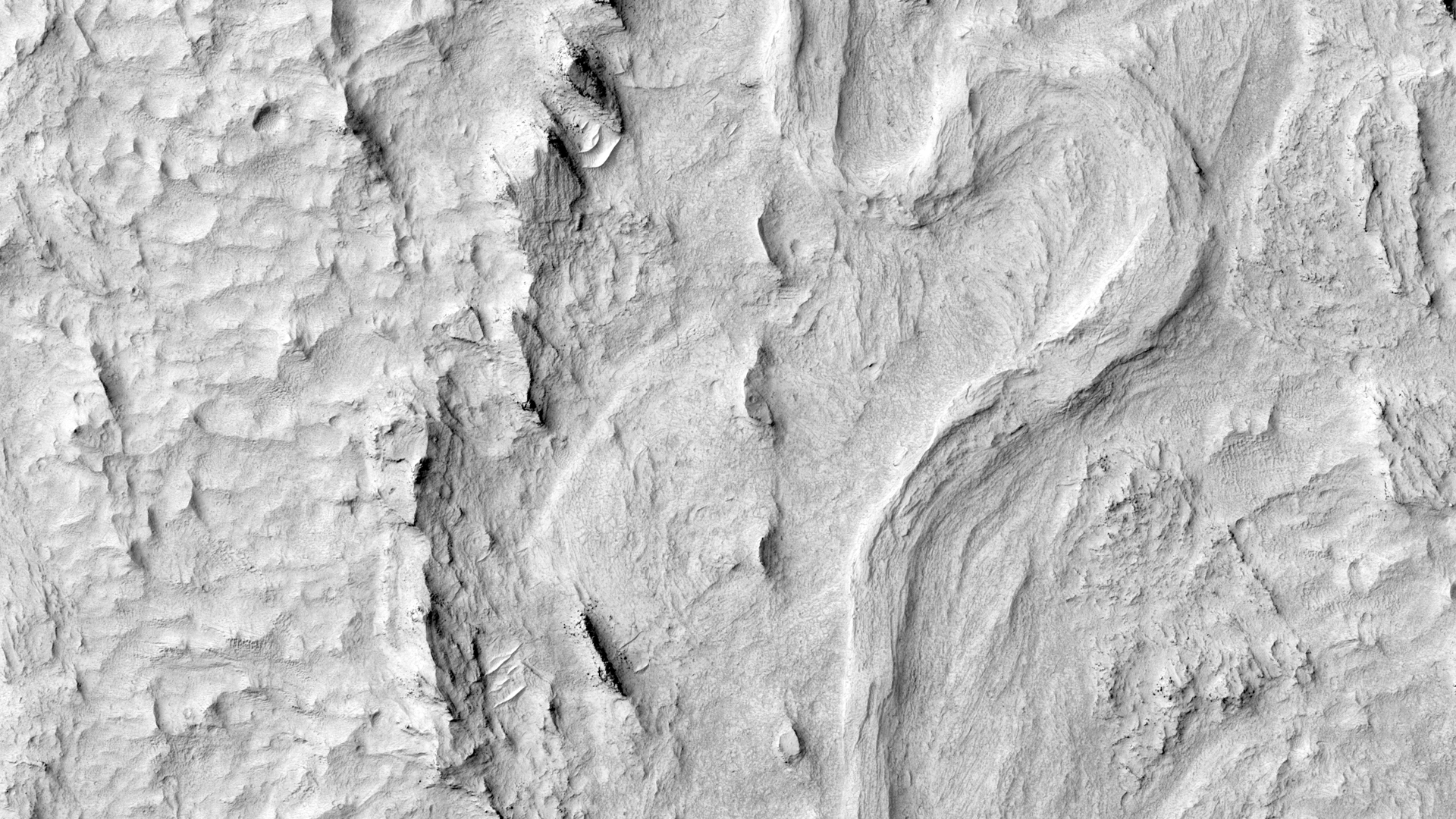
The Ancient Meandering Rivers of Mars
The Ancient Meandering Rivers of Mars
The Ancient Meandering Rivers of Mars
by Ian O'Neill, Discovery News, Feb. 3, 2104
http://news.discovery.com/space/the-ancient-meandering-rivers-of-mars-140203.htm
http://dannyboston.blogspot.com/2014/02/the-ancient-meandering-rivers-of-mars.html
Sinuous Ridges and Meanders
ESP_034189_1740: Fluvial Processes
http://hirise.lpl.arizona.edu/ESP_034189_1740
http://hirise.lpl.arizona.edu/ESP_034044_1740
http://static.uahirise.org/images/2014/details/cut/ESP_034189_1740-2.jpg
Fairen, A. G., N. S. Davies, and S. W. Squyres, 2013,
Equatorial Ground Ice and Meandering Rivers on Mars
http://www.lpi.usra.edu/meetings/lpsc2013/pdf/2948.pdf
44th Lunar and Planetary Science Conference, The
Woodlands, Texas. LPI Contribution No. 1719, p.2948
http://www.lpi.usra.edu/meetings/lpsc2013/pdf/2948.pdf
Yours,
Paul H.
The Ancient Meandering Rivers of Mars
by Ian O'Neill, Discovery News, Feb. 3, 2104
http://news.discovery.com/space/the-ancient-meandering-rivers-of-mars-140203.htm
http://dannyboston.blogspot.com/2014/02/the-ancient-meandering-rivers-of-mars.html
Sinuous Ridges and Meanders
ESP_034189_1740: Fluvial Processes
http://hirise.lpl.arizona.edu/ESP_034189_1740
http://hirise.lpl.arizona.edu/ESP_034044_1740
http://static.uahirise.org/images/2014/details/cut/ESP_034189_1740-2.jpg
Fairen, A. G., N. S. Davies, and S. W. Squyres, 2013,
Equatorial Ground Ice and Meandering Rivers on Mars
http://www.lpi.usra.edu/meetings/lpsc2013/pdf/2948.pdf
44th Lunar and Planetary Science Conference, The
Woodlands, Texas. LPI Contribution No. 1719, p.2948
http://www.lpi.usra.edu/meetings/lpsc2013/pdf/2948.pdf
Yours,
Paul H.
Monday, 17 February 2014
Pingos not so rare and not so mysterious was Strange (Landform) in Siberia
Pingos not so rare and not so mysterious was Strange (Landform) in Siberia
In “Pingos not so rare and not so mysterious was
Strange (Landform) in Siberia” at
http://lists.drizzle.com/pipermail/rockhounds_lists.drizzle.com/2014-February/002504.html
Eman wrote:
“This file shows the basalt and tuff surface geology of
the Siberian Trapps--again covering the Irkustsk Region:
http://en.wikipedia.org/wiki/File:Extent_of_Siberian_traps_german.png
Note the extensive lobes of lava flow on the Irkustsk
southern border.”
The above inferences that are made above from an
extremely generalized and quite vague geologic map
from Wikipedia showing the extent of then Siberian
trap are completely wrong according to direct field
observations made of the geology of the Patom Cone
(a.k.a. Patomsky crater, Patom crater, or Eagle Nest)
by Soviet and Russian geologists, who have visited it.
Both the Wikipedia map and especially its source map
on the Mantle Plumes web site are quite useless in
determining the local geology of the Patom Cone.
These maps lack the needed resolution; their scale is
much too small; and their outcrops are far too
generalized to be of any use. Descriptions of the local
geology of Patom Cone area by Alekseyev (2012),
Antipin and Fedorov (2008), and Ermolin et al. (2011)
all demonstrate that volcanic rocks associated with the
Siberian Traps or any other volcanism are completely
absent from the immediate vicinity of the Patom Cone.
Instead, the local bedrock consists of folded, Proterozoic
limestones and quartz sandstones of the Mariinsk
Formation The Patom Cone rests directly on the
southwestward dipping limestones of the Mariinsk
Formation as shown the above papers.
Eman also wrote:
“Now consult the ground or space photos ( original
links and/or Goggle Earth) of this cone and note the
apparent adjacent lava strata exposures and their down
slope orientation.”
Geological maps in the published literature, i.e.
Figure 2 of Antipin and Fedorov (2008), clearly
demonstrate that the “apparent adjacent lava strata
exposures” consist only of Proterozoic limestone and
quartz sandstone of the Mariinsk Formation. They
are dipping to the southwest at 25 to 40 degrees.
Eman also wrote:
“This is consistent with the formation conditions for
pingo and also explains the presence of a block of
"pillow lava" in the cone's center.”
Descriptions of lithology of the rock comprising the
Patom Cone can be found in Alekseyev (2012) and
Antipin and Fedorov (2008) In these descriptions of the
Patom Crater that can be found in the above papers,
there is a complete lack of any mention of any pillow
lava or any other volcanic rock having been found in
rock that comprises the Patom Cone. Specifically the
Patom Cone consists of 1 massive crystalline limestones
with quartz–muscovite carbonate veins; 2. Massive
fine-grained crystalline limestones with quartz veins;
and 3. weathered limestone rubble with rare blocks
of metamorphosed sandstones and schists. No mention
is made in any of the published papers that I have
found of the occurrence of either “pillow lavas” or
other volcanic rocks either in or associated with this
landform. Finally, the uncaptioned web page images,
which have been interpreted to be pillow lavas, are
clearly not pillow lavas. More likely, the features seen
in these images are the either spheroidal weathering
of highly deformed mudstones. There is a complete
absence of any documented evidence in the published
literature for the occurrence of Siberian traps or any
other volcanic rocks within the immediate vicinity the
Patom Cone.
One problem is that I cannot find any discussion of
where the pictures that have been interpreted to be
"pillow lava" were taken. It is unknown whether pictures
of the so-called "pillow lavas" are of either part of the
Patom Cone or adjacent outcrops.
Eman also wrote:
“Were this a feature (Patomsky Krater) studied by a
present day geologist…”
According to the published literature, the Patom Cone
was discovered in 1949 and has been periodically
studied and published on by Russian and Soviet
geologists since 1951 up until a 2012 paper, Alekseyev
(2012). The published literature clearly demonstrates
that “present day geologists” have been studying and
publishing on the Patom Cone. One problem is that
“naive photo journalists” and bloggers have ignored the
published research and instead decided to be
entertaining over being scientific. The other problem
is that much of the published literature is in Russian
and buried in paper publications with the exception
of the papers that can be found online. Fortunately, my
wife is fluent in both Russian and English and can
translate Russian-language geology papers for me.
As far as the Patom Cone being an unique structure,
Antipin and Fedorov (2008) noted that they have
searched the region of the Patom Cone in detail. As
Russian geologists, they and the Soviet geologists
before them would have access to aerial photocopy
that outside geologists would not have access to.
Antipin and Fedorov (2008) specifically states:
“Patom Crater (Fig. 1) is unique and the only object
of this kind in the vast area of Patom Highland.”
Since 1951, i.e. Kolpakov (1951), Soviet and Russian
geologists have been searching the region for additional
landforms like the of the Patom Cone and have found
none. If they conclude that it is an unique landform for
the region, I have to go along with their evaluation
unless someone can provide hard, well-documented
evidence to the contrary instead of hypothetical arm-
waving about how difficult it is to search the region.
I have met and know Soviet field geologists enough to
know that they are quite capable of mapping of geology
under very difficult circumstance in the field. Also, the
Soviet government and later the current Russian
government and private companies have devoted
enormous resources to geological mapping, including
the use of aerial imagery and other remote sensing, that
far exceeds what western governments had even begun
of thinking of doing. They have a an amazing grasp of
the geology of Russia that seems to be greatly
underestimated and underappreciated on this list. In
addition, the area of the Patom Cone has been the subject
of very detailed studies and searches using dedicated
aerial imagery and geophysical methdos in past several
years as noted in Alekseyev (2012). From what I have
found the Soviet and Russian geologists, who have
studied this landform, regard it as being unique within
the Patom Highlands in which it lies.
I agree that the Patom Cone is likely an odd sort of
periglacial landform, possibly related to pingos. However,
it is far more complicated in origin than being just
another “pingo.” Mindlessly dismissing this feature as a
“pingo” grossly disregards the unique features of this
landform that have been discussed in detail by the
geologists, i.e. Alekseyev (2012), Antipin and Fedorov
(2008), Antipin et al. (2011), Ermolin (2011), and
Kolpakov (1951), who have studied this landform in
the field and published on it.
References Cited
Alekseyev ,V.R., 2012. Cryovolcanism and the mystery
of the Patom cone. Geodynamics & Tectonophysics.
vol. 3, no. 3, pp. 289–307. doi:10.5800/GT-2012-3-3-0075.
http://popovgeo.professorjournal.ru/c/document_library/get_file?p_l_id=22997&folderId=69343&name=DLFE-36927.pdf
http://gt.crust.irk.ru/images/upload/tblarticle83/magazin83.pdf
http://gt.crust.irk.ru/article_83.html and
http://gt.crust.irk.ru/magazin2012_3.en.html
Antipin, V. S., and A. M. Fedorov, 2008, The origin of
Patom Crater, East Siberia, from geological and
geochemical data. Doklady Earth Sciences. vol. 423,
no. 2, pp. 1335-1339
http://link.springer.com/article/10.1134%2FS1028334X08090018
Antipin, V. S., A. M. Fedorov, S. I. Dril’, and V. I. Voronin,
2011, The new data on the origin of the Patom Crater (East
Siberia). Doklady Earth Sciences. vol. 440, no. 2, pp. 1391-1395
http://link.springer.com/article/10.1134%2FS1028334X11100187
Ermolin, E., O. Ingerov, and А. Saviсhev, 2012, Results of
AMT survey of Patom crater area. Extended Abstract, 21st
EM Induction Workshop Darwin, Australia, July 25-31, 2012.
http://www.21emiw.com/LiteratureRetrieve.aspx?ID=117868\\\
Kolpakov, V.V., 1951. A mysterious crater in the Patom
highland. Priroda. vol. 2, pp. 58–59.
Other papers expressing diverse opinions are:
Stazhevskii, S. B., 2011, Origination and development
mechanics of the Earth's morphostructures. Part I: Etiology
and evolution of the Patomsky crater. Journal of Mining
Science. vol. 47, no. 4, pp. 413-426.
http://link.springer.com/article/10.1134%2FS1062739147040034
Stazhevskii, S. B., 2012, Origination and development
mechanics of the Earth’s morphostructures. Part II: The
nature of diatreme, karst and trappean formations, and
the Chicxulub Crater origin. Journal of Mining Science.
vol. 48, no. 1, pp. 55-70.
http://link.springer.com/article/10.1134%2FS1062739148010078
Yours,
Paul H.
In “Pingos not so rare and not so mysterious was
Strange (Landform) in Siberia” at
http://lists.drizzle.com/pipermail/rockhounds_lists.drizzle.com/2014-February/002504.html
Eman wrote:
“This file shows the basalt and tuff surface geology of
the Siberian Trapps--again covering the Irkustsk Region:
http://en.wikipedia.org/wiki/File:Extent_of_Siberian_traps_german.png

Note the extensive lobes of lava flow on the Irkustsk
southern border.”
The above inferences that are made above from an
extremely generalized and quite vague geologic map
from Wikipedia showing the extent of then Siberian
trap are completely wrong according to direct field
observations made of the geology of the Patom Cone
(a.k.a. Patomsky crater, Patom crater, or Eagle Nest)
by Soviet and Russian geologists, who have visited it.
Both the Wikipedia map and especially its source map
on the Mantle Plumes web site are quite useless in
determining the local geology of the Patom Cone.
These maps lack the needed resolution; their scale is
much too small; and their outcrops are far too
generalized to be of any use. Descriptions of the local
geology of Patom Cone area by Alekseyev (2012),
Antipin and Fedorov (2008), and Ermolin et al. (2011)
all demonstrate that volcanic rocks associated with the
Siberian Traps or any other volcanism are completely
absent from the immediate vicinity of the Patom Cone.
Instead, the local bedrock consists of folded, Proterozoic
limestones and quartz sandstones of the Mariinsk
Formation The Patom Cone rests directly on the
southwestward dipping limestones of the Mariinsk
Formation as shown the above papers.
Eman also wrote:
“Now consult the ground or space photos ( original
links and/or Goggle Earth) of this cone and note the
apparent adjacent lava strata exposures and their down
slope orientation.”
Geological maps in the published literature, i.e.
Figure 2 of Antipin and Fedorov (2008), clearly
demonstrate that the “apparent adjacent lava strata
exposures” consist only of Proterozoic limestone and
quartz sandstone of the Mariinsk Formation. They
are dipping to the southwest at 25 to 40 degrees.
Eman also wrote:
“This is consistent with the formation conditions for
pingo and also explains the presence of a block of
"pillow lava" in the cone's center.”
Descriptions of lithology of the rock comprising the
Patom Cone can be found in Alekseyev (2012) and
Antipin and Fedorov (2008) In these descriptions of the
Patom Crater that can be found in the above papers,
there is a complete lack of any mention of any pillow
lava or any other volcanic rock having been found in
rock that comprises the Patom Cone. Specifically the
Patom Cone consists of 1 massive crystalline limestones
with quartz–muscovite carbonate veins; 2. Massive
fine-grained crystalline limestones with quartz veins;
and 3. weathered limestone rubble with rare blocks
of metamorphosed sandstones and schists. No mention
is made in any of the published papers that I have
found of the occurrence of either “pillow lavas” or
other volcanic rocks either in or associated with this
landform. Finally, the uncaptioned web page images,
which have been interpreted to be pillow lavas, are
clearly not pillow lavas. More likely, the features seen
in these images are the either spheroidal weathering
of highly deformed mudstones. There is a complete
absence of any documented evidence in the published
literature for the occurrence of Siberian traps or any
other volcanic rocks within the immediate vicinity the
Patom Cone.
One problem is that I cannot find any discussion of
where the pictures that have been interpreted to be
"pillow lava" were taken. It is unknown whether pictures
of the so-called "pillow lavas" are of either part of the
Patom Cone or adjacent outcrops.
Eman also wrote:
“Were this a feature (Patomsky Krater) studied by a
present day geologist…”
According to the published literature, the Patom Cone
was discovered in 1949 and has been periodically
studied and published on by Russian and Soviet
geologists since 1951 up until a 2012 paper, Alekseyev
(2012). The published literature clearly demonstrates
that “present day geologists” have been studying and
publishing on the Patom Cone. One problem is that
“naive photo journalists” and bloggers have ignored the
published research and instead decided to be
entertaining over being scientific. The other problem
is that much of the published literature is in Russian
and buried in paper publications with the exception
of the papers that can be found online. Fortunately, my
wife is fluent in both Russian and English and can
translate Russian-language geology papers for me.
As far as the Patom Cone being an unique structure,
Antipin and Fedorov (2008) noted that they have
searched the region of the Patom Cone in detail. As
Russian geologists, they and the Soviet geologists
before them would have access to aerial photocopy
that outside geologists would not have access to.
Antipin and Fedorov (2008) specifically states:
“Patom Crater (Fig. 1) is unique and the only object
of this kind in the vast area of Patom Highland.”
Since 1951, i.e. Kolpakov (1951), Soviet and Russian
geologists have been searching the region for additional
landforms like the of the Patom Cone and have found
none. If they conclude that it is an unique landform for
the region, I have to go along with their evaluation
unless someone can provide hard, well-documented
evidence to the contrary instead of hypothetical arm-
waving about how difficult it is to search the region.
I have met and know Soviet field geologists enough to
know that they are quite capable of mapping of geology
under very difficult circumstance in the field. Also, the
Soviet government and later the current Russian
government and private companies have devoted
enormous resources to geological mapping, including
the use of aerial imagery and other remote sensing, that
far exceeds what western governments had even begun
of thinking of doing. They have a an amazing grasp of
the geology of Russia that seems to be greatly
underestimated and underappreciated on this list. In
addition, the area of the Patom Cone has been the subject
of very detailed studies and searches using dedicated
aerial imagery and geophysical methdos in past several
years as noted in Alekseyev (2012). From what I have
found the Soviet and Russian geologists, who have
studied this landform, regard it as being unique within
the Patom Highlands in which it lies.
I agree that the Patom Cone is likely an odd sort of
periglacial landform, possibly related to pingos. However,
it is far more complicated in origin than being just
another “pingo.” Mindlessly dismissing this feature as a
“pingo” grossly disregards the unique features of this
landform that have been discussed in detail by the
geologists, i.e. Alekseyev (2012), Antipin and Fedorov
(2008), Antipin et al. (2011), Ermolin (2011), and
Kolpakov (1951), who have studied this landform in
the field and published on it.
References Cited
Alekseyev ,V.R., 2012. Cryovolcanism and the mystery
of the Patom cone. Geodynamics & Tectonophysics.
vol. 3, no. 3, pp. 289–307. doi:10.5800/GT-2012-3-3-0075.
http://popovgeo.professorjournal.ru/c/document_library/get_file?p_l_id=22997&folderId=69343&name=DLFE-36927.pdf
http://gt.crust.irk.ru/images/upload/tblarticle83/magazin83.pdf
http://gt.crust.irk.ru/article_83.html and
http://gt.crust.irk.ru/magazin2012_3.en.html
Antipin, V. S., and A. M. Fedorov, 2008, The origin of
Patom Crater, East Siberia, from geological and
geochemical data. Doklady Earth Sciences. vol. 423,
no. 2, pp. 1335-1339
http://link.springer.com/article/10.1134%2FS1028334X08090018
Antipin, V. S., A. M. Fedorov, S. I. Dril’, and V. I. Voronin,
2011, The new data on the origin of the Patom Crater (East
Siberia). Doklady Earth Sciences. vol. 440, no. 2, pp. 1391-1395
http://link.springer.com/article/10.1134%2FS1028334X11100187
Ermolin, E., O. Ingerov, and А. Saviсhev, 2012, Results of
AMT survey of Patom crater area. Extended Abstract, 21st
EM Induction Workshop Darwin, Australia, July 25-31, 2012.
http://www.21emiw.com/LiteratureRetrieve.aspx?ID=117868\\\
Kolpakov, V.V., 1951. A mysterious crater in the Patom
highland. Priroda. vol. 2, pp. 58–59.
Other papers expressing diverse opinions are:
Stazhevskii, S. B., 2011, Origination and development
mechanics of the Earth's morphostructures. Part I: Etiology
and evolution of the Patomsky crater. Journal of Mining
Science. vol. 47, no. 4, pp. 413-426.
http://link.springer.com/article/10.1134%2FS1062739147040034
Stazhevskii, S. B., 2012, Origination and development
mechanics of the Earth’s morphostructures. Part II: The
nature of diatreme, karst and trappean formations, and
the Chicxulub Crater origin. Journal of Mining Science.
vol. 48, no. 1, pp. 55-70.
http://link.springer.com/article/10.1134%2FS1062739148010078
Yours,
Paul H.
Subscribe to:
Posts (Atom)