Including Original "Paul H. Letters" Copyright © 1996-2025 Paul V. Heinrich / website © 1996-2025 Dirk Ross - All rights reserved.


Tuesday, 18 April 2006

A Couple of Online Articles About Australian Tektites

A Couple of Online Articles About Australian Tektites

Paul bristolia at yahoo.com
Tue Apr 18 13:36:25 EDT 2006

Dear List Members,

While browsing the Internet, I came across a couple
of articles, which are available online as PDF
documents, which might be of interest to people on
this list.

One of them is:

Pillans, Brad, 2004, Tektites as Chronostratigraphic
Markers in Australian Regolith. In I. Roach, ed.,
pp. 279-281, Proceedings of the CRC LEME Regional
Regolith Symposia, November 2004, Adelaide, Perth
and Canberra.

Apparently, Dr. Pillans, as a part of his research is
looking for tektites, which have detailed information
concerning where they were found. The article stated:

“As part of the CRC LEME geochronology
project I would like to hear from anyone
who has found tektites. I also encourage
all of you to be alert to tektites in
your field work.”

He definitely encourages people to make detailed notes
on location and the context of any tektites, which they
find, much like is done now for meteorites.

This article can be found at:

http://leme.anu.edu.au/Pubs/Monographs/regolith2004/Pillans_b.pdf

The source of this article is:

http://leme.anu.edu.au/Pubs/Monographs/Regolith2004.html

http://crcleme.org.au/Pubs/Monographs/regolith2004/a_abstract%20volume%20front.pdf

Another paper, which discusses tektites, is:

Brad Pillans, 2004, Geochronology of the Australian
Regolith, (c) CRC LEME 2004 Geochronology

This article can be found at:

http://crcleme.org.au/RegLandEvol/Geochron_of_%20Aust_Regolith.pdf

Another online paper, which mentions tektites, is:

Pillans, B., 2003, Subdividing the Pleistocene using
the Matuyama-Brunhes boundary (MBB): an Australasian
perspective. Quaternary Science Reviews. vol. 22,
pp. 1569-1577.

It can be found at:

http://www.quaternary.stratigraphy.org.uk/noticeboard/pillans.pdf

A list of his publications can fopund at:

http://wwwrses.anu.edu.au/environment/eePages/eePeople/eeBradPillans.html

Best Regards,

Paul


Monday, 17 April 2006

Searching for Information on "Mahuika Crater" (New Zealand) and Any Associated Tektites

Searching for Information on "Mahuika Crater" (New Zealand) and Any Associated Tektites

Paul bristolia at yahoo.com
Mon Apr 17 15:55:54 EDT 2006

Dear Listmembers,

I am looking for information, including citations for any
published papers, about the age and origin of what has
been called the "Mahuika Crater", which is located off
of the coast of New Zealand. Also, have tektites actually
been found associated with it?

Best Regards,

Paul
Louisiana

Wednesday, 12 April 2006

New Paper on Bedout High, Australia, in EPSL

New Paper on Bedout High, Australia, in EPSL

Paul bristolia at yahoo.com
Wed Apr 12 17:16:00 EDT 2006

There is a paper about a geophysical study of the Bedout High,
one porposed site for a end of Permain imapct, just off of the
nothwest corner of Australia.

Muller, R. D., A. Goncharov, and A. Kritski, 2006, Geophysical
evaluation of the enigmatic Bedout basement high, offshore
northwestern Australia. Earth and Planetary Science Letters.
vol. 237. pp. 264–284.

They concluded:

"The available geophysical and geological data are compatible
with an interpretation of the Bedout structure as a basement
high formed by two consecutive Paleozoic and Mesozoic
episodes of rifting roughly orthogonal to each other, associated
with basin formation east and west of the Bedout High, but
fail nearly all unequivocal criteria for impact crater recognition."

Sunday, 2 April 2006

Columbian Impact Structure (??) and Deccan Basalts was “Multiple Impact and 73P

Columbian Impact Structure (??) and Deccan Basalts was “Multiple Impact and 73P

Paul bristolia at yahoo.com
Sat Apr 1 12:05:42 EST 2006

In “Multiple Impact and 73P(was..More Evidence
Chicxulub..)”, MexicoDoug at aol.com wrote


>Sterling W. writes:

<< Keller-Harting get lots of press, but nobody
<>

>

>Hola Sterling,

>

>The idea that multiple impacts ocurred doesn't

>seem to far fetched, and we can basically thank

>them for introducing it as potentially more viable

>and consistent based on top-notch fieldwork, not

>just astronomical mullings.”


Columbian Impact Structure ??

This discussion reminded me a geologic structure, which
was found in seismic surveys made for oil and gas
exploration, lying beneath the Columbian continental
shelf. It was a huge, possibly larger than Chicxulub,
circular stucture, which was a candidate for the K/T
impact site, until it was found. Once Chicxulub was
found and published, it seems to have been completely
forgotten. Does anyone know if anything had ever been
published on it? Might this still be an alternate possibility
for the K/T killer?

The Deccan Flood Basalts, An Additional Complication

To further complicate the K/T boundary controversy,
there are these findings and interpretations:

India’s Smoking Gun: Dino-Killing Eruptions
Geological Society of America Press Release, 9
August 2005

http://www.geosociety.org/news/pr/05-27.htm

The abstract stated:

“In fact, most mass extinctions over the past 300 million
years have coincided with large volcanic events, said
Chenet. The general rule is that massive volcanism
like the Deccan Traps correlates with all major mass
extinctions in Earth's history, she said.”

Another article is “Volcanic prepping for dinosaur
extinction” from the October 2005 Geotimes at:

http://www.agiweb.org/geotimes/oct05/NN_volcextinction.html

The abstract discussed in the above articles is:

Chenet, A.-L. Courtillot, V., Fluteau, F., Besse, J.,
Subbarao, K. V., Khadri, S., Bajpai, S., and Jay, A., 2005,
Magnetostratigraphy of the Upper Formations of the
Deccan Traps: an Constraint on the Timing of the
Eruptive Sequence. Session no. T9. Large Igneous
Provinces: Their Biotic, Climatic, and Oceanic Impact,
Earth System Processes 2 Meeting, August 8-11, 2005.
Calgary, Alberta.

http://gsa.confex.com/gsa/2005ESP/finalprogram/abstract_88502.htm

I find it fascinating that there seems to exist a far better
correlation between eruption of massive flood basalts
and mass extinctions than there is between impact
events and mass extinctions. This is discussed in an
interesting abstract:

Courtillot, V., and Thordarson, T., 2005, Flood basalts
appear to be the main cause of biological mass
extinctions in the Phanerozoic. Geophysical Research
Abstracts, Vol. 7, 11196, 2005
SRef-ID: 1607-7962/gra/EGU05-A-11196

http://meetings.copernicus.org/egu2005/download/EGU05-J-11196-1.pdf

The who, what, and when of the K/T extinction event is
far from a settled matter.

Best

Paul

Thursday, 30 March 2006

Part2: Professor Rejects Meteor Theory of Carolina Bays' Origin

Part2: Professor Rejects Meteor Theory of Carolina Bays' Origin

Paul bristolia at yahoo.com
Wed Mar 29 14:53:22 EST 2006

Susan Web wrote:

“Their key mysterious features are their
number (half a million of them), their
regularity of form, their common
orientation, their extreme shallowness,
their low rim heights.”

Their “common orientation” is not as consistent as the
proponents of an impact origin falsely claim them to be.
In the southern and northern ends of their distribution,
the long axis of Carolina Bays actually show a wide
range of orientations, which fails to support either an
air-burst or impact origin. Within the middle range of
their distribution, the orientation of the Carolina Bays
are consistent with Pleistocene paleowind directions as
determined from ancient dune fields, loess distribution
patterns, and paleoclimate models. I would find it quite
remarkable that either a meteorite or comet would take
the time and trouble to plan its impact as to perfectly
coincide with the prevailing winds at the time it hit like
an airplane landing at an airport. The wide spread of
orientations at the northern and southern ends of their
distributions is also consistent with what is known about
the variability of Pleistocene paleowind patterns over
time.

Another and major problem, which the proponents of either
an impact or air-burst origin is that the shape, orientation,
and depth of the Carolina Bays have been altered by over
a 100,000 years of modification by eolian and lacustrine
processes. For example, Ivester et al. (2003) found that
the multiple sand rims found within Big Bay in South
Carolina become progressively younger towards the center
of this Carolina Bay. In this case, Optically Stimulated
Luminescence (OSL) dates from sand rims starting from
the outer rim to the inner rim produced a perfectly
chronologically consistent set dates of 35,660±2600;
25,210±1900; 11,160±900; and 2,150±300 years BP. In
this case, the Big Bay has shrunk by 1.6 km over the last
36,000 years, with rims being produced about 36,000 BP,
25,000 BP, 11,000 BP, and 2,000 BP as it shrunk. If a
person wants to argue that these sand rims are of impact or
air-burst origin, they need to explain how either impacts or
air-bursts managed to precisely excavate tens of thousand
of years apart sucessive craters in precise center of Big Bay
and similar Carolina Bays and with ever decreasing energy
as to produce sand rims of smaller and smaller diameter,
which are nicely nested within each other.

Their nothing mysterious about these rims as (Ivester et al.
2004a) studied the sedimentology and stratigraphy of these
rims and found them to be “composed of both shoreface
and eolian deposits". Eolian and lacustrine processes are
perfectly capable of producing the low rims processes by
Carolina Bays. The low rims can be easily explained by a
combination of eolian and lacustrine processes.

As a result of the OSL dating of the rims of numerous Carolina
Bays, Ivester et al (2004b) concluded:

"The optical dating results indicate that
present-day bay morphology is not the
result of a single event, catastrophic
formation, but rather they have evolved
through multiple phases of activity and
inactivity over tens of thousands of years.
This is evidenced both by multiple rims
of differing ages along the same bay, and
by multiple ages within single rims."

Because the Carolina Bays have been modified for over a
100,000 years by both eolian and lacustine processes, their
form, orientation, shallowness, and sand rims are useless as
evidence of how they were originally created.

References Cited:

Ivester, A.H., Godfrey-Smith, D. I., Brooks, M. J., and
Taylor, B. E., 2003, Concentric sand rims document the
evolution of a Carolina bay in the Middle Coastal Plain
of South Carolina. Geological Society of America
Abstracts with Programs. vol. 35, no. 6, pp. 169.

Ivester, A. H., Godfrey-Smith, D. I., Brooks, M. J., and
Taylor B. E., 2004a, The timing of Carolina Bay and
inland activity on the Atlantic coastal plain of Georgia
and South Carolina. Geological Society of America
Abstracts with Programs. vol. 36, no. 5, p. 69

Ivester, A. H., Godfrey-Smith, D. I., Brooks, M. J., and
Taylor B. E., 2004b, Chronology of Carolina bay sand
rims and inland dunes on the Atlantic Coastal Plain, USA.
The 3rd New World Luminescence Dating Workshop. July
4 - 7, 2004, Department of Earth Science, Dalhousie
University, Halifax, Nova Scotia.

Mrs. Webb also wrote:

“It is also worth noting that all the
geological theories of their origins
are based on the erroneous notion
that the Carolina Bays are all to be
found in only one type of geological
terrain, the coastal plains. But they
have since been found in other terrain
types, which effectively rules out
most of the prior geological theories
(except for those fish fins, of course).”

Unfortunately, the only “erroneous notion” here is the
pervasive Internet folklore about Carolina Bays having
been found on a variety of geologic terrains. The fact
of the matter is that Carolina Bays are **not** found in
a diverse assortment geologic terrains. The Internet
fiction about Carolina Bays being found in a wide range
of geologic terrains was soundly refuted by the detailed
analysis, which May and Warme (1999) did of Carolina
Bays, including those found within the coastal plains of
Mississippi and Alabama. They found that these bays
are restricted to deeply weathered, very low relief, and
very poorly drained, geomorphic surfaces.

Reference Cited:

May, James H., and Warne, Andrews G., 1999, Hydrogeologic
and Chemical Factors Required for the Development of
Carolina Bays Along the Atlantic and Gulf of Mexico Coastal
Plain, USA. Environmental Engineering and Geoscience.
vol. 5, no. 3, pp. 261-270.

The abstract for May and Warme (1999) can be found at:

http://eeg.geoscienceworld.org/cgi/content/abstract/5/3/261

Best,

Paul

Re: Professor Rejects Meteor Theory of Carolina Bays' Origin

Re: Professor Rejects Meteor Theory of Carolina Bays' Origin

Paul bristolia at yahoo.com
Wed Mar 29 10:29:52 EST 2006

Thaddeus Besedin wrote:

“Is it known if any metals associated with and
transported by meteorites have been detected
in any substantive concentrations in cores or
other samples?

Ron Baalke wrote:

http://www.thetandd.com/articles/2006/03/28/news/doc4428a99f752a6396001544.txt

No. There has not been any convincing association between
iridium or any related elements, meteorites, and the Carolina
Bays. Some of the data concerning the age of the Carolina
Bays and papers on their origin is noted in a popular article at:

http://www.hallofmaat.com/modules.php?name=Articles&file=article&sid=86

Some interesting web pages:

Abstracts by Ivester and others:

http://gsa.confex.com/gsa/2002AM/finalprogram/abstract_45547.htm
http://gsa.confex.com/gsa/2004AM/finalprogram/abstract_78899.htm

Luminescence dating of Carolina Bay sand rims

http://www.westga.edu/~aivester/pr01.htm

Paul

Monday, 20 March 2006

Discussion On Whether Chicxulub Impact Killed the Dinosaurs or Not

Discussion On Whether Chicxulub Impact Killed the Dinosaurs or Not

Paul bristolia at yahoo.com
Sun Mar 19 23:31:59 EST 2006

Chicxulub discussion page

Welcome to the Chicxulub discussion page

This page contains discussion related to Keller, Adatte &
Stinnesbeck's article, The Non-Smoking Gun.
http://www.geolsoc.org.uk/template.cfm?name=NSG2349857238495
http://www.geolsoc.org.uk/template.cfm?name=NSG1
http://www.geolsoc.org.uk/template.cfm?name=NSG93854738475347
http://www.geolsoc.org.uk/template.cfm?name=NSG999999

RE: Article on paleo-Bolide porduced tsunamites/seismites

RE: Article on paleo-Bolide produced tsunamites/seismites

Paul bristolia at yahoo.com
Sun Mar 19 23:30:29 EST 2006

jonee (Elton) asked:

"Anyone have a link as to specifically what tsunamites
and seismites are defined as?"

There is a definition of "tsunamite" in:

Shanmugam, G., 2006, The Tsunamite Problem. Journal
of Sedimentary Research. vol. 76. DOI: 10.2110/jsr.2006.073

http://www.colorado.edu/geolsci/jsedr/Abstracts/may2006/ShanmugamAbs.pdf
http://www.colorado.edu/geolsci/jsedr/Abstracts/may2006/jsr76-5.html

The above abstract stated:

"The genetic term tsunamite is used for a potpourri
of deposits formed from a wide range of processes
(overwash surges, backwash flows, oscillatory flows,
combined flows, soft-sediment deformation, slides,
slumps, debris flows, and turbidity currents) related
to tsunamis in lacustrine, coastal, shallow-marine,
and deep-marine environments."

Although they are called "Tsunami Sand Deposits", pictures
of coastal plain "tsunamites" created by the December Indian
Ocean Tsunami can be seen in:

"The December 26, 2004 Indian Ocean Tsunami: Initial
Findings on Tsunami Sand Deposits, Damage, and
Inundation in Sri Lanka" at:

http://walrus.wr.usgs.gov/tsunami/srilanka05/tsunami_sand_deposit.html
http://walrus.wr.usgs.gov/tsunami/srilanka05/sand.html

and in "Tsunami deposits (figure 3: thickness of the deposits)" at:

http://perso.wanadoo.fr/raphael.paris/tsunami.htm

Another coastal tsunami deposit (tsunamite) from the
1929 Grand Banks Earthquake found at Taylor's Bay on
Newfoundland's southern coast can be seen at:

http://www.seismo.nrcan.gc.ca/damage/1929/1929tuttleresearch.php

A definition of "seismite" can be found in "Developing a Classification
Scheme for Seismites" by Stephen F. Greb at:

http://gsa.confex.com/gsa/2002NC/finalprogram/abstract_32750.htm

This abstract for the 2002 North-Central Section (36th) and
Southeastern Section (51st), Geological Society of America Joint
Annual Meeting stated:

"The term "seismite" is presently used for many features and
deposits of inferred seismic origin, each of which requires
varying types and amounts of data to support a seismic
interpretation."

One type of seismite is sediment that show disturbance /
deformation, while it was still soft, caused by the ground
shaking, which accompanies an earthquake. Some pictures
of seismites can be found in "The Late Triassic seismite
in Northern Ireland, southwest England and south Wales" at:

http://www.habitas.org.uk/larne/assortedseismites.html

A related article might be:

Walkden, G., J. Parker, and S. Kelley, 2002, A Late Triassic
Impact Ejecta Layer in Southwestern Britain. Science. vol. 298,
no. 5601, pp. 2185-2188. DOI: 10.1126/science.1076249
http://www.sciencemag.org/cgi/content/short/298/5601/2185

The Entrada Sandstone contains soft sediment deformation
features, which are argued to be impact-related seismites.
This is discussed in:

Alvarez, W., E. Staley, D. O'Connor, and M. A. Chan, 1998,
Synsedimentary deformation in the Jurassic of southeastern
Utah: A case of impact shaking? Geology. vol. 26, no. 7,
pp. 579-582.

http://eps.berkeley.edu/~platetec/125.pdf

a press release can be found at:

http://www.sciencedaily.com/releases/1998/10/981006073850.htm

Best

Paul

Saturday, 18 March 2006

Astronomers Map Earliest Evidence of Big Bang

Astronomers Map Earliest Evidence of Big Bang

Paul bristolia at yahoo.com
Fri Mar 17 19:52:43 EST 2006

New Three Year Results on the Oldest Light in the Universe
http://map.gsfc.nasa.gov/m_or/PressRelease_03_06.html
and http://map.gsfc.nasa.gov/m_mm.html

Microwave map of the sky can be found at:
http://map.gsfc.nasa.gov/m_ig/060917/CMB_ILC_PolMap150bk.png

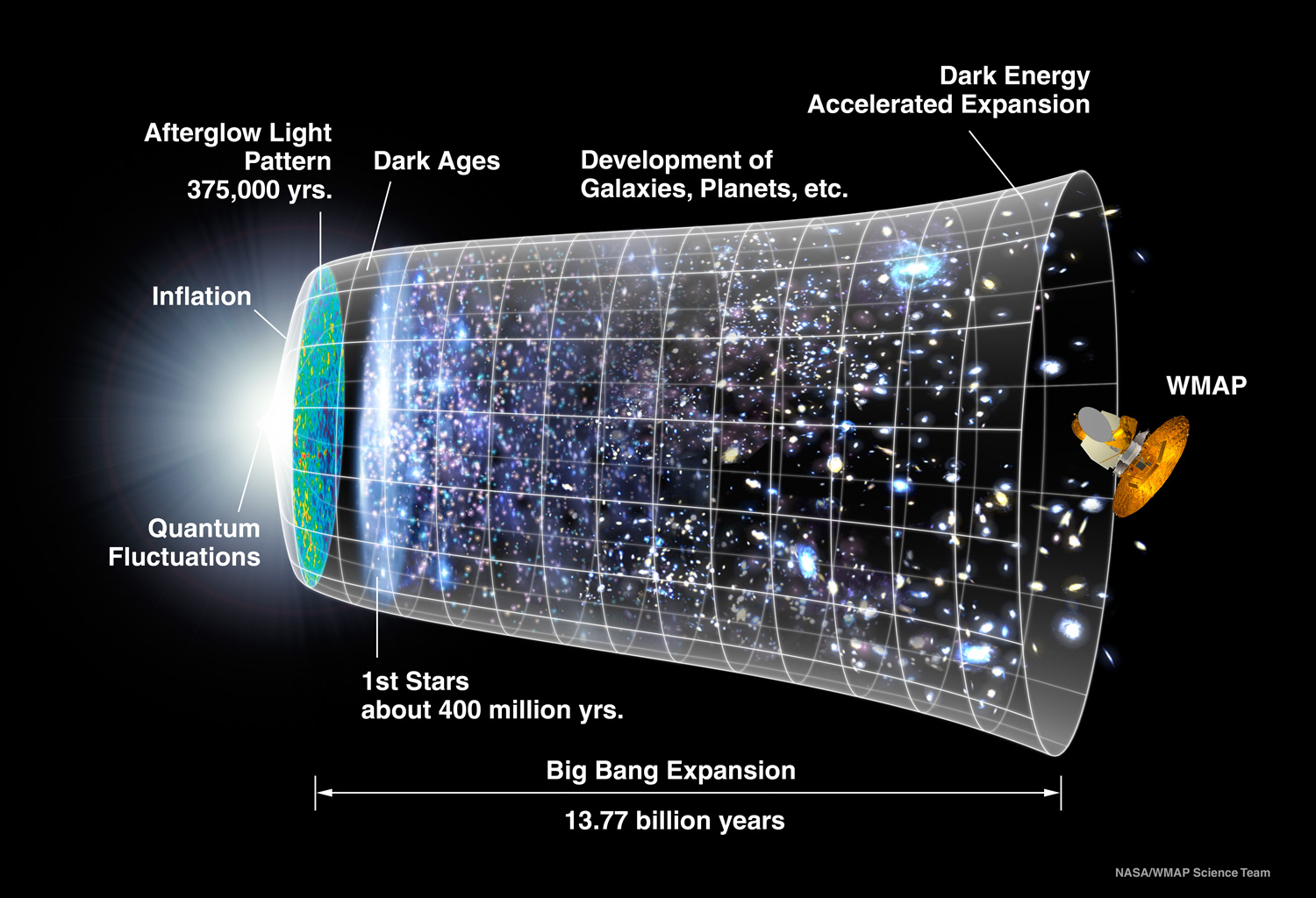
Time Line of the Universe
http://map.gsfc.nasa.gov/m_ig/060915/CMB_Timeline150.jpg

Other articles:

New Satellite Data On Universe's First Trillionth Second
Science Daily, Johns Hopkins University, March 17, 2006
http://www.sciencedaily.com/releases/2006/03/060316181253.htm

Astronomers Find the Earliest Signs Yet of a Violent Baby Universe
By DENNIS OVERBYE, New York Times, March 17, 2006
http://www.nytimes.com/2006/03/17/science/space/17cosmos.html

New Images Support 'Big Bang' Theory
Washington Post, by Guy Gugliotta, March 17, 2006
http://www.washingtonpost.com/wp-dyn/content/article/2006/03/16/AR2006031601889.html
http://www.washingtonpost.com/wp-dyn/content/article/2006/03/16/AR2006031601889_pf.html

Re: Large Impact Crater Off the Coast of Antarctica

Re: Large Impact Crater Off the Coast of Antarctica

Paul bristolia at yahoo.com
Fri Mar 17 17:05:41 EST 2006

Ron Baalke wrote:

"http://news.bbc.co.uk/1/hi/sci/tech/4816794.stm
Space impact clue in Antarctica By Paul Rincon
BBC News, March 17, 2006"

A couple of relevant published papers are:

Published papers on this alleged crater are:

Hrjanina, L. P., 1998, Once Again about Kainozoic Meteorite Structures
in the Ross Sea, Antarctica. Lunar and Planetary Science XXIX,
http://www.lpi.usra.edu/meetings/LPSC98/pdf/1152.pdf

Gerard-Little, P., D. Abbott, D. Breger, and L. Burckle, 2006, Evidence
for a Possible Late Pliocene Impact in the Ross Sea, Antarctica. Lunar
and Planetary Science XXXVII.
http://www.lpi.usra.edu/meetings/lpsc2006/pdf/1399.pdf

Another paper is:

Khryanina, L. P.,1985, Possible meteorite impact structures in the
Ross Sea, Antarctica. International Geology Review. vol. 27, no. 10,
pp.1207-1211.

Yours,

Paul

Thursday, 16 March 2006

RE: Desert Varnish formation

RE: Desert Varnish formation

Paul bristolia at yahoo.com
Wed Mar 15 17:09:53 EST 2006

Kevin Forbes wrote:

“Desert Varnish formation
http://waynesword.palomar.edu/ploct97.htm”

A couple of related references are:

Quade, Jay, 2001: Desert pavements and associated
rock varnish in the Mojave Desert: How old can they
be?. Geology. vol. 29, no. 9, pp. 855–858.

and

Broecker, W. S., and Liu. T., 2001: Rock Varnish:
Recorder of Desert Wetness?. GSA Today. vol. 11,
no. 8, pp. 4–10.
doi: 10.1130/1052-5173(2001)011<0004:rvrodw>2.0.CO;2

The PDF version of Broecker and Liu (2001) can
be downloaded from:

http://www.gsajournals.org/pdfserv/10.1130%2F1052-5173(2001)011%3C0004:RVRODW%3E2.0.CO%3B2

http://www.gsajournals.org/gsaonline/?request=get-abstract&doi=10.1130%2F1052-5173(2001)011%3C0004:RVRODW%3E2.0.CO%3B2

Reassembly of the above URLs might be needed. If you do not paste
the full URLs into your browser, a message incorrectly stating that
you will need to buy the GSA Today article will appear.

Best Regards,

Paul

How to Discover Asteroid Impacts

How to Discover Asteroid Impacts

Paul bristolia at yahoo.com
Wed Mar 15 17:06:20 EST 2006

How to discover asteroid impacts
The story of the discovery of two impact craters
By Emilio González, March 13, 2006
http://www.astroseti.org/impacts.php

Wednesday, 15 March 2006

RE: Desert Varnish formation

RE: Desert Varnish formation

Paul bristolia at yahoo.com
Tue Mar 14 10:34:13 EST 2006

Kevin Forbes wrote:

“Desert Varnish formation
http://waynesword.palomar.edu/ploct97.htm”

A couple of related references are:

Quade, Jay, 2001: Desert pavements and associated
rock varnish in the Mojave Desert: How old can they
be?. Geology. vol. 29, no. 9, pp. 855–858.

and

Broecker, W. S., and Liu. T., 2001: Rock Varnish:
Recorder of Desert Wetness?. GSA Today. vol. 11,
no. 8, pp. 4–10.
doi: 10.1130/1052-5173(2001)011<0004:rvrodw>2.0.CO;2

The PDF version of Broecker and Liu (2001) can
be downloaded from:

http://www.gsajournals.org/pdfserv/10.1130%2F1052-5173(2001)011%3C0004:RVRODW%3E2.0.CO%3B2

http://www.gsajournals.org/gsaonline/?request=get-abstract&doi=10.1130%2F1052-5173(2001)011%3C0004:RVRODW%3E2.0.CO%3B2

Reassembly of the above URLs might be needed.

Best Regards,

Paul

Wednesday, 8 March 2006

Strange Newspaper Headline About Meteorites

Strange Newspaper Headline About Meteorites

Paul bristolia at yahoo.com
Wed Mar 8 14:30:22 EST 2006

Dear Friends,

Jay Leno's Tonight Show showed a headline about meteorites,
which you-all might appreciate. It can be seen at:

http://www.nbc.com/nbc/The_Tonight_Show_with_Jay_Leno/headlines/H_3095/26.shtml#headline

Yours,

Paul

Wednesday, 22 February 2006

Smithsonian Tektite Publciation on Ebay (AD?)

Smithsonian Tektite Publciation on Ebay (Add??)

Paul bristolia at yahoo.com
Wed Feb 22 12:25:55 EST 2006

Dear Friends,

While surfing through Ebay, I noticed a tektite publication for sale,
which might be of interest to someone on this list. It is:

Occurence, Distribution, and Age of Australian Tektites,
Smithsonian Contributions to the Earth Sciences no.17 (1976)

It can be found in "3 SI Earth Sciences Bks Australian Tektites CANADA",
Item number: 4614410243 (Ends Feb-23-06 18:47:17 PST) at;

http://cgi.ebay.com/3-SI-Earth-Sciences-Bks-Australian-Tektites-CANADA_W0QQitemZ4614410243QQcategoryZ378QQrdZ1QQcmdZViewItem

This is not my add. Also, I have no idea, who the person selling
this item is. Thus, you bid on this item at your own risk.

Although I have no use for this paper myself, it seems like a significant
enough publication that it deserves a good home with someone, who is
interested in teltites.

Best Regards,

Paul

Friday, 6 January 2006

Did "Red Rain" Dump Alien Microbes on Earth ??

Did "Red Rain" Dump Alien Microbes on Earth ??

Paul bristolia at yahoo.com
Fri Jan 6 16:57:40 EST 2006

The below article appeared while "Googling" for meteorites.
All sorts of wierd and unexplained stuff seems to fall from
they sky every so often.

Skepticism greets claim of possible alien microbes
Jan. 5, 2006, Special to World Science
http://www.world-science.net/exclusives/060104_specksfrm.htm

"A paper to appear in a scientific journal claims a strange
red rain might have dumped microbes from space onto
Earth four years ago.

But the report is meeting with a shower of skepticism
from scientists who say extraordinary claims require
extraordinary proof—and this one hasn’t got it."

+++++

Astrophysics, abstract
astro-ph/0601022

From: Godfrey Louis [view email]
Date: Mon, 2 Jan 2006 07:54:10 GMT (461kb)
The red rain phenomenon of Kerala and its possible
extraterrestrial origin.

http://arxiv.org/abs/astro-ph/0601022

Have Fun,

Paul

Thursday, 29 December 2005

Meteorite Impact Observed the Moon

Meteorite Impact Observed the Moon

Paul bristolia at yahoo.com
Wed Dec 28 17:06:24 EST 2005

An Explosion on the Moon: So you thought nothing ever happens
on the moon? Dr. Tony Phillips, Science at NASA, [

http://science.nasa.gov/headlines/y2005/22dec_lunartaurid.htm?list109322

"December 23, 2005: NASA scientists have observed an explosion
on the moon. The blast, equal in energy to about 70 kg of TNT,
occurred near the edge of Mare Imbrium (the Sea of Rains) on
Nov. 7, 2005, when a 12-centimeter-wide meteoroid slammed
into the ground traveling 27 km/s."

Wednesday, 21 December 2005

Wikipedia and Meteorites

Wikipedia and Meteorites

Paul bristolia at yahoo.com
Wed Dec 21 00:26:08 EST 2005

Recently, there was a study in Nature, which compared the
quality of articles in Wikipedia to the quality of articles in the
Encyclopedia Britannica. One news article was:

Journal: Wikipedia as accurate as Britannica
Nature study covered side-by-side comparison of scientific
topics, CNN News, December 15, 2005, at:

http://www.cnn.com/2005/TECH/internet/12/15/wikipedia.ap/index.html

Nature paper discussed in this article is;

Giles, Jim, 2005, Internet encyclopaedias go head to head. Nature.
vol. 438, no. 7070 pp 900. doi:10.1038/438900a at;

http://www.nature.com/nature/journal/v438/n7070/full/438900a.html and
http://www.nature.com/nature/journal/v438/n7070/box/438900a_BX1.html

This article stated:

"Wikipedia has become the 37th most visited website, according
to Alexa, a web ranking service."

If Wikipedia is the 37th most visited website, then it would certainly
be a place where members of this list can educate the public about
various aspects of meteorites. Looking at the meteorite-related
articles on Wikipedia, there are many articles, which could use some
input from members of this list. If a person looks up the Canyon
Diablo meteorite and pallasites, a person finds only a bear stub of
an article. Examples of woefully incomplete articles are.

Canyon Diablo meteorite at;
http://en.wikipedia.org/wiki/Canyon_Diablo_meteorite

pallasite at:
http://en.wikipedia.org/wiki/Pallasites

Howardite at
http://en.wikipedia.org/wiki/Howardite

Many of the categories linked at "Meteorite classification are missing
articles or have the next to nothing in them as can be seen by checking
the links for them at:

http://en.wikipedia.org/wiki/Meteorites_classification

Given the traffic that this site gets, it might be worth the effort to
create some decent entries in the Wikipedia about various aspects
of meteorites,

Best Regards,

Paul

Sunday, 27 November 2005

Odessa Crater (Texas) Determined to be About 63, 500 Years Old

Odessa Crater (Texas) Determined to be About 63, 500 Years Old

Paul bristolia at yahoo.com
Sat Nov 26 10:37:28 EST 2005

In December 2005 issue of “Geology” the below article about
the Odessa Crater in Texas has been published.

Holliday, Vance T., Kring, David A., Mayer, James H., and
Goble, Ronald J., 2005, Age and effects of the Odessa
meteorite impact, western Texas, USA., Geology. vol. 33,
no. 12, pp. 945–948.

This article noted that optically stimulated luminescence
dates of sediments filling it demonstrate that this crater was
created about 63,500, plus or minus 4,500, thousand years
ago.

Its full abstract can be found at:

http://www.gsajournals.org/gsaonline/?request=get-current-toc&issn=0091-7613

The same issue of Geology also has the following articles:

Collins, Gareth S., and Wunnemann, Kia, 2005, How big was
the Chesapeake Bay impact? Insight from numerical modeling.
Geology. vol. 33, no. 12, pp. 925–928.

They concluded that the original transient crater was only 40
km in diameter. The full abstract can be found at:

http://www.gsajournals.org/gsaonline/?request=get-abstract&doi=10.1130%2FG21854.1

and

Sephton, Mark A., Looy, Cindy V., Brinkhuis, H., Wignall,
Paul B., de Leeuw, Jan W., and Visscher, Henk, 2005,
Catastrophic soil erosion during the end-Permian biotic
crisis. Geology. vol. 33, no. 12, pp. 941-944.

Its abstract can be found at:

http://www.gsajournals.org/gsaonline/?request=get-abstract&doi=10.1130%2FG21784.1

Best Regards,

Paul

Wednesday, 2 November 2005

Correction to "Re: Last Word (from me) on the Crackpot Theory, I Think..."

Correction to "Re: Last Word (from me) on the Crackpot Theory, I Think..."

Paul bristolia at yahoo.com
Tue Nov 1 12:32:57 EST 2005

In my last post at
http://six.pairlist.net/pipermail/meteorite-list/2005-November/178653.html ,
my thinking and argument drifted from TL dating to OSL dating.
My paragraph concerning the TL dating should have read:

"One significant problem here is that thermoluminescent dating
presumes a steady level of radiation damage over time by the
decay of radioactive elements trapped in the chert. Irradiation
strong enough to have altered the isotopic composition of the
uranium in chert would have also caused extensive radiation
damage to the microcrystalline quartz composing the chert.
Therefore, had what Firestone and his colleagues claimed to
have occurred, actually happened, any thermoluminescent
dates from the effected site should have also been altered to
the point of providing apparent dates considerably older than
the associated Paleo-Indian artifacts. The fact, that the
thermoluminescent dates are only slightly older, which is
common due to incomplete thermal resetting of the chert,
than age of the culture affiliated with the Paleo-Indian
artifacts, strongly refutes the idea that these sites were
irradiated at all. Had these sites been irradiated as much as
proposed by Firestone, then the ages given by the
thermoluminescent dates would have given apparent dates
significantly older than the artifacts actually are, which was
not the case."

I apologize for this brain fart.

Best Regards,

Paul