New PhD. Dissertation About Younger Dryas Impact Hypothesis
van Hoesel, A., 2014, The Younger Dryas climate change
was it caused by an extraterrestrial impact? Utrecht
studies in Earth Sciences no. 54. Utrecht University,
Utrecht, Netherlands. 141 pp. ISBN: 978-90-6266-356-9
(Open Access Theses and Dissertations)
http://dspace.library.uu.nl:8080/handle/1874/294136
http://dspace.library.uu.nl:8080/bitstream/handle/1874/294136/vanHoesel.pdf?sequence=2
Some other miscellaneous publications:
van Hoesel, A., 2012, The Younger Dryas impact
hypothesis: a critical review. (poster)
https://www.academia.edu/1232265/The_Younger_Dryas_impact_hypothesis_a_critical_review
van Hoesel, A., 2012, Een meteorietinslag aan hetbegin
van de Jonge Dryas? Geo.brief June 2012, pp. 10-11.
https://www.academia.edu/4189150/Een_meteorietinslag_aan_het_begin_van_de_Jonge_Dryas
https://leidenuni.academia.edu/AnneliesvanHoesel
Yours,
Paul H.

Wednesday, 25 June 2014
Charity Shoal Crater, an Exhumed Middle Ordovician Impact Crater
Charity Shoal Crater, an Exhumed Middle Ordovician Impact Crater
Holcombe, T. L., S. Youngblut, and N. Slowey, 2013,
Geological structure of Charity Shoal crater, Lake
Ontario, revealed by multi beam bathymetry. Geo-Marine
Letters. col. 33, no. 4, pp 245-252
http://link.springer.com/article/10.1007%2Fs00367-013-0322-6
http://adsabs.harvard.edu/abs/2013GML....33..245H
They argue that the Charity Shoal Crater in Lake
Ontario formed as the result of an extraterrestrial
impact event in a shallow marine environment during
the Middle Ordovician. After the impact, it was
eventually buried by post-impact marine
sedimentation, which covered it with fossiliferous
marine carbonate strata. Much later, they argue,
it was exhumed by Pleistocene glacial erosion.
Other publications are:
Holcombe, T. L., J. S. Warren, D. F. Reid, W. T.
Virden, and D. L. Divins, 2001, Small Rimmed Depression
in Lake Ontario: An Impact Crater? Journal of Great
Lakes Research. vol. 27, no. 4, pp. 510-517
PDF file at http://www.glerl.noaa.gov/pubs/fulltext/2001/20010012.pdf
abstract at https://www.sciencedirect.com/science/journal/03801330/27/4
Phillip, S. A., 2013, High-resolution lake-based
magnetic mapping and modelling of basement structures,
with examples from Küçükçekmece Lagoon, Turkey and
Charity Shoal, Lake Ontario. unpublished MS thesis,
School of Geography and Earth Sciences, McMaster
University, Hamilton, Ontario. 113 pp.
https://macsphere.mcmaster.ca/handle/11375/13532
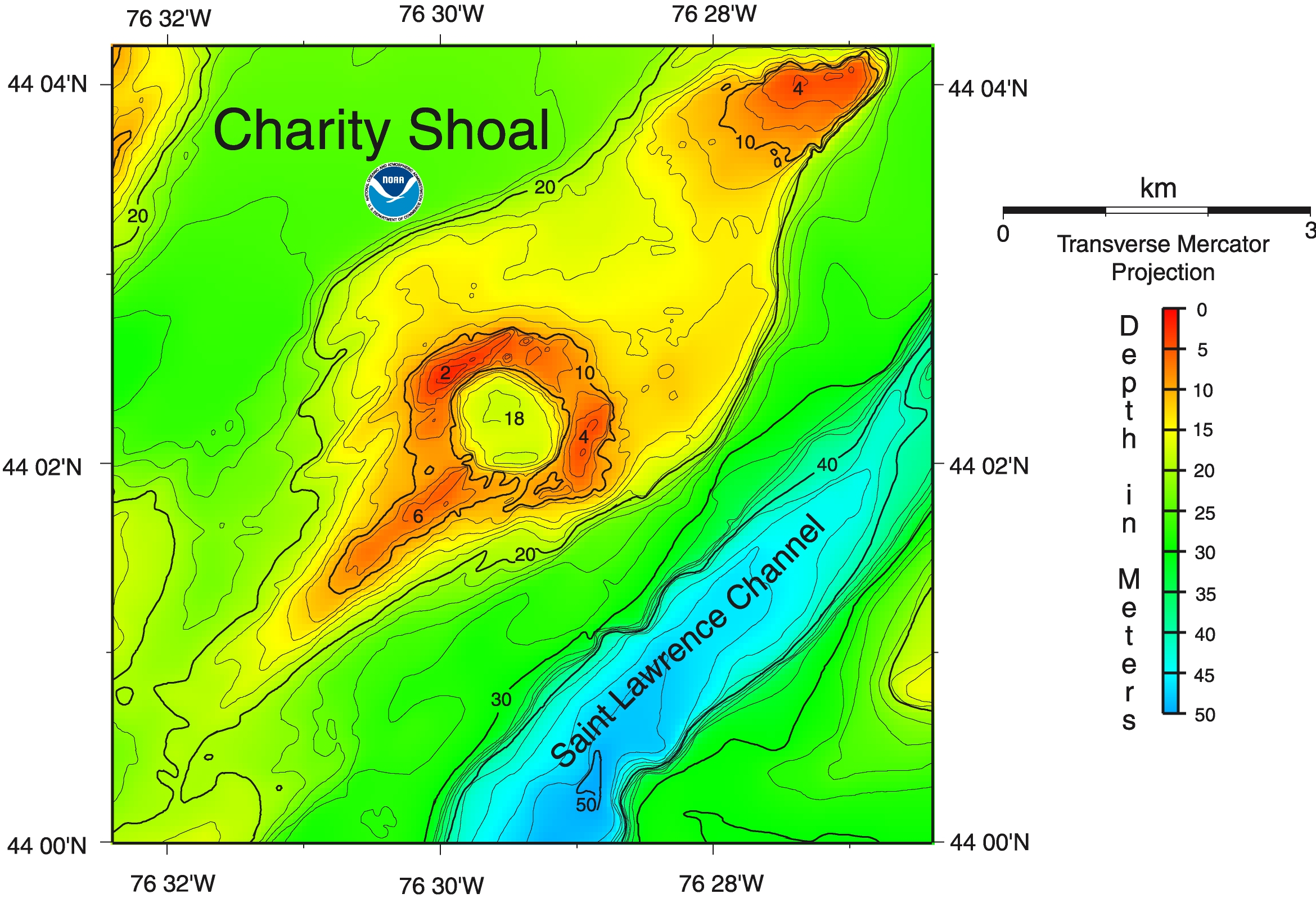
Bathymetric map of Charity Crater area.
Great Lakes Data Rescue Project - Lake Ontario Bathymetry
https://www.ngdc.noaa.gov/mgg/greatlakes/lakeontario_cdrom/html/area12.htm
https://www.ngdc.noaa.gov/mgg/greatlakes/lakeontario_cdrom/images/a12_lg.jpg
Yours,
Paul H.
Holcombe, T. L., S. Youngblut, and N. Slowey, 2013,
Geological structure of Charity Shoal crater, Lake
Ontario, revealed by multi beam bathymetry. Geo-Marine
Letters. col. 33, no. 4, pp 245-252
http://link.springer.com/article/10.1007%2Fs00367-013-0322-6
http://adsabs.harvard.edu/abs/2013GML....33..245H
They argue that the Charity Shoal Crater in Lake
Ontario formed as the result of an extraterrestrial
impact event in a shallow marine environment during
the Middle Ordovician. After the impact, it was
eventually buried by post-impact marine
sedimentation, which covered it with fossiliferous
marine carbonate strata. Much later, they argue,
it was exhumed by Pleistocene glacial erosion.
Other publications are:
Holcombe, T. L., J. S. Warren, D. F. Reid, W. T.
Virden, and D. L. Divins, 2001, Small Rimmed Depression
in Lake Ontario: An Impact Crater? Journal of Great
Lakes Research. vol. 27, no. 4, pp. 510-517
PDF file at http://www.glerl.noaa.gov/pubs/fulltext/2001/20010012.pdf
abstract at https://www.sciencedirect.com/science/journal/03801330/27/4
Phillip, S. A., 2013, High-resolution lake-based
magnetic mapping and modelling of basement structures,
with examples from Küçükçekmece Lagoon, Turkey and
Charity Shoal, Lake Ontario. unpublished MS thesis,
School of Geography and Earth Sciences, McMaster
University, Hamilton, Ontario. 113 pp.
https://macsphere.mcmaster.ca/handle/11375/13532
Bathymetric map of Charity Crater area.
Great Lakes Data Rescue Project - Lake Ontario Bathymetry
https://www.ngdc.noaa.gov/mgg/greatlakes/lakeontario_cdrom/html/area12.htm
https://www.ngdc.noaa.gov/mgg/greatlakes/lakeontario_cdrom/images/a12_lg.jpg
Yours,
Paul H.

Monday, 16 June 2014
The Proterozoic Oxygen Rise
The Proterozoic Oxygen Rise
Earth's breathable atmosphere a result of continents
taking control of the carbon cycle, University of
Exeter, Science Daily, June 9, 2014
http://www.sciencedaily.com/releases/2014/06/140609153433.htm
http://www.exeter.ac.uk/news/featurednews/title_385882_en.html
Mills, B., T. M. Lenton, and A. J. Watson, 2014,
Proterozoic oxygen rise linked to shifting balance
between seafloor and terrestrial weathering.
Proceedings of the National Academy of Sciences
of the United States of America. Published online
before print June 9, 2014.
http://www.pnas.org/content/early/2014/06/04/1321679111
A related article is:
Geologists confirm oxygen levels of ancient oceans
Syracuse University, Science Daily, June 10, 2014
http://www.sciencedaily.com/releases/2014/06/140610144656.htm
http://www.sciencenewsline.com/summary/2014061016380031.html
Hardisty, D. S. , Z. Lu, N. J. Planavsky, A. Bekker,
P. Philippot, X. Zhou, and T. W. Lyons, 2014, An
iodine record of Paleoproterozoic surface ocean
oxygenation. Geology. First published online May 22, 2014,
http://geology.gsapubs.org/content/early/2014/05/21/G35439.1
A related paper is:
Lyons, T. W., C. T. Reinhard, and N. J. Planavsky, 2014,
The rise of oxygen in Earth’s early ocean and atmosphere.
Nature. vol. 506, no. 7488, pp. 307-315.
http://www.nature.com/nature/journal/v506/n7488/full/nature13068.html
PDF file at: http://media.egu.eu/media/documents/2014/22/oxygenreviewnature.pdf
Yours,
Paul H.
Earth's breathable atmosphere a result of continents
taking control of the carbon cycle, University of
Exeter, Science Daily, June 9, 2014
http://www.sciencedaily.com/releases/2014/06/140609153433.htm
http://www.exeter.ac.uk/news/featurednews/title_385882_en.html
Mills, B., T. M. Lenton, and A. J. Watson, 2014,
Proterozoic oxygen rise linked to shifting balance
between seafloor and terrestrial weathering.
Proceedings of the National Academy of Sciences
of the United States of America. Published online
before print June 9, 2014.
http://www.pnas.org/content/early/2014/06/04/1321679111
A related article is:
Geologists confirm oxygen levels of ancient oceans
Syracuse University, Science Daily, June 10, 2014
http://www.sciencedaily.com/releases/2014/06/140610144656.htm
http://www.sciencenewsline.com/summary/2014061016380031.html
Hardisty, D. S. , Z. Lu, N. J. Planavsky, A. Bekker,
P. Philippot, X. Zhou, and T. W. Lyons, 2014, An
iodine record of Paleoproterozoic surface ocean
oxygenation. Geology. First published online May 22, 2014,
http://geology.gsapubs.org/content/early/2014/05/21/G35439.1
A related paper is:
Lyons, T. W., C. T. Reinhard, and N. J. Planavsky, 2014,
The rise of oxygen in Earth’s early ocean and atmosphere.
Nature. vol. 506, no. 7488, pp. 307-315.
http://www.nature.com/nature/journal/v506/n7488/full/nature13068.html
PDF file at: http://media.egu.eu/media/documents/2014/22/oxygenreviewnature.pdf
Yours,
Paul H.
Sunday, 15 June 2014
Where have all the craters gone?
Where have all the craters gone?
Where have all the craters gone? Geological Society
of America, ScienceDaily, May 27, 2014
http://www.sciencedaily.com/releases/2014/05/140527154715.htm
The paper is:
Johnson, B. C., and T. J. Bowling, 2014, Where have
all the craters gone? Earth's bombardment history and
the expected terrestrial cratering record. Geology.
First published online May 22, 2014, doi: 10.1130/G35754.1
http://geology.gsapubs.org/content/early/2014/05/21/G35754.1
An older and related article is:
Tiny 'spherules' reveal details about Earth's asteroid
impacts, Purdue University, April 25, 2012
http://www.purdue.edu/newsroom/research/2012/120425MeloshImpacts.html
http://www.sciencedaily.com/releases/2012/04/120425140316.htm
The paper is:
Johnson, B. C., and H. J. Melosh, 2012, Impact
spherules as a record of an ancient heavy bombardment
of Earth. Nature. vol. 485, no. 7396, pp. 75–77.
http://www.nature.com/nature/journal/v485/n7396/full/nature10982.html
Yours,
Paul H.
-----
MikeG wrote:
>(Keep posting the links though - every
>now and then, one of the papers is free)
The abstract for the PDF of the Lunar and Planetary
Science Conference version of Johnson and Bowling
(2014) is at http://www.hou.usra.edu/meetings/lpsc2014/pdf/2414.pdf
Th PDF file of Johnson and Melosh (2012) is at
http://211.144.68.84:9998/91keshi/Public/File/34/485-7396/pdf/nature10982.pdf
Yours,
Paul H.
Where have all the craters gone? Geological Society
of America, ScienceDaily, May 27, 2014
http://www.sciencedaily.com/releases/2014/05/140527154715.htm
The paper is:
Johnson, B. C., and T. J. Bowling, 2014, Where have
all the craters gone? Earth's bombardment history and
the expected terrestrial cratering record. Geology.
First published online May 22, 2014, doi: 10.1130/G35754.1
http://geology.gsapubs.org/content/early/2014/05/21/G35754.1
An older and related article is:
Tiny 'spherules' reveal details about Earth's asteroid
impacts, Purdue University, April 25, 2012
http://www.purdue.edu/newsroom/research/2012/120425MeloshImpacts.html
http://www.sciencedaily.com/releases/2012/04/120425140316.htm
The paper is:
Johnson, B. C., and H. J. Melosh, 2012, Impact
spherules as a record of an ancient heavy bombardment
of Earth. Nature. vol. 485, no. 7396, pp. 75–77.
http://www.nature.com/nature/journal/v485/n7396/full/nature10982.html
Yours,
Paul H.
-----
MikeG wrote:
>(Keep posting the links though - every
>now and then, one of the papers is free)
The abstract for the PDF of the Lunar and Planetary
Science Conference version of Johnson and Bowling
(2014) is at http://www.hou.usra.edu/meetings/lpsc2014/pdf/2414.pdf
Th PDF file of Johnson and Melosh (2012) is at
http://211.144.68.84:9998/91keshi/Public/File/34/485-7396/pdf/nature10982.pdf
Yours,
Paul H.
Friday, 13 June 2014
Four-billion-year-old rocks yield clues about Earth's earliest crust
Four-billion-year-old rocks yield clues about Earth's earliest crust
Four-billion-year-old rocks yield clues about Earth's
earliest crust. ScienceDaily, University of Alberta
http://www.sciencedaily.com/releases/2014/05/140529112057.htm
News360 at http://news360.com/article/241073278 ; and
Ancient rocks yield clues about Earth's earliest crust
by Bryan Alary, University of Alberta, May 28, 2014
http://news.ualberta.ca/newsarticles/2014/may/ancient-rocks-yield-clues-about-earths-earliest-crust
Reimink, J. R., T. Chacko, R. A. Stern, L. M. Heaman,
2014, Earth’s earliest evolved crust generated in an
Iceland-like setting. Nature Geoscience. Published
online May 25, 2014 10.1038/ngeo2170
http://www.nature.com/ngeo/journal/vaop/ncurrent/full/ngeo2170.html
A related article is:
Lunar Rocks Are First Direct Evidence of Collision
That Formed Moon, National eographic, June 6, 2014.
http://news.nationalgeographic.com/news/2014/06/140605-earth-moon-theia-evidence-space-science/
Body that formed the Moon came from a different
neighborhood. (The body that smacked into Earth
has a distinctive elemental signature.) Ars Technica
http://arstechnica.com/science/2014/06/body-that-formed-the-moon-came-from-a-different-neighborhood/
Herwartz, D., A. Pack, B. Friedrichs, and A. Bischoff,
2014, Identification of the giant impactor Theia in lunar
rocks. Science. vol. 344, no. 6188, pp. 1146-1150
DOI: 10.1126/science.1251117
http://www.sciencemag.org/content/344/6188/1146
yours,
Paul H.
Four-billion-year-old rocks yield clues about Earth's
earliest crust. ScienceDaily, University of Alberta
http://www.sciencedaily.com/releases/2014/05/140529112057.htm
News360 at http://news360.com/article/241073278 ; and
Ancient rocks yield clues about Earth's earliest crust
by Bryan Alary, University of Alberta, May 28, 2014
http://news.ualberta.ca/newsarticles/2014/may/ancient-rocks-yield-clues-about-earths-earliest-crust
Reimink, J. R., T. Chacko, R. A. Stern, L. M. Heaman,
2014, Earth’s earliest evolved crust generated in an
Iceland-like setting. Nature Geoscience. Published
online May 25, 2014 10.1038/ngeo2170
http://www.nature.com/ngeo/journal/vaop/ncurrent/full/ngeo2170.html
A related article is:
Lunar Rocks Are First Direct Evidence of Collision
That Formed Moon, National eographic, June 6, 2014.
http://news.nationalgeographic.com/news/2014/06/140605-earth-moon-theia-evidence-space-science/
Body that formed the Moon came from a different
neighborhood. (The body that smacked into Earth
has a distinctive elemental signature.) Ars Technica
http://arstechnica.com/science/2014/06/body-that-formed-the-moon-came-from-a-different-neighborhood/
Herwartz, D., A. Pack, B. Friedrichs, and A. Bischoff,
2014, Identification of the giant impactor Theia in lunar
rocks. Science. vol. 344, no. 6188, pp. 1146-1150
DOI: 10.1126/science.1251117
http://www.sciencemag.org/content/344/6188/1146
yours,
Paul H.
Thursday, 12 June 2014
A Long-Ago Ancestor: A Little Fish, With Jaws to Come
A Long-Ago Ancestor: A Little Fish, With Jaws to Come
A Long-Ago Ancestor: A Little Fish, With Jaws to Come
by Carl Zimmer, New York Times, June 11, 2014
http://www.nytimes.com/2014/06/12/science/a-long-ago-ancestor-a-little-fish-with-incipient-jaws.html
New fossil find pinpoints the origin of jaws in vertebrates
PhysOrg, June 11, 2014
http://phys.org/news/2014-06-fossil-jaws-vertebrates.html
Chew On This Fantastic New Fossil by Jane Hu, Slate
http://www.slate.com/blogs/wild_things/2014/06/11/new_fossil_shows_evolution_of_jaws_metaspriggina_gill_arches_from_the_burgess.html
The paper is:
Morris, S. M., and J.-B. Caron, 2014, A primitive fish
from the Cambrian of North America. Nature, Published
online 11 June 2014http://www.nature.com/nature/journal/vaop/ncurrent/full/nature13414.html
Additional web pages:
Metaspriggina, Wikipedia,
https://en.wikipedia.org/wiki/Metaspriggina
Metaspriggina walcotti, The Burgess Shale, Royal
Ontario Museum http://burgess-shale.rom.on.ca/en/fossil-gallery/view-species.php?id=81
Yours,
Paul H.
A Long-Ago Ancestor: A Little Fish, With Jaws to Come
by Carl Zimmer, New York Times, June 11, 2014
http://www.nytimes.com/2014/06/12/science/a-long-ago-ancestor-a-little-fish-with-incipient-jaws.html
New fossil find pinpoints the origin of jaws in vertebrates
PhysOrg, June 11, 2014
http://phys.org/news/2014-06-fossil-jaws-vertebrates.html
Chew On This Fantastic New Fossil by Jane Hu, Slate
http://www.slate.com/blogs/wild_things/2014/06/11/new_fossil_shows_evolution_of_jaws_metaspriggina_gill_arches_from_the_burgess.html
The paper is:
Morris, S. M., and J.-B. Caron, 2014, A primitive fish
from the Cambrian of North America. Nature, Published
online 11 June 2014http://www.nature.com/nature/journal/vaop/ncurrent/full/nature13414.html
Additional web pages:
Metaspriggina, Wikipedia,
https://en.wikipedia.org/wiki/Metaspriggina
Metaspriggina walcotti, The Burgess Shale, Royal
Ontario Museum http://burgess-shale.rom.on.ca/en/fossil-gallery/view-species.php?id=81
Yours,
Paul H.
Saturday, 7 June 2014
Lunar Rocks Are First Direct Evidence of Collision That Formed Moon
Lunar Rocks Are First Direct Evidence of Collision That Formed Moon
Lunar Rocks Are First Direct Evidence of Collision
That Formed Moon, National eographic, June 6, 2014.
http://news.nationalgeographic.com/news/2014/06/140605-earth-moon-theia-evidence-space-science/
Body that formed the Moon came from a different
neighborhood. (The body that smacked into Earth
has a distinctive elemental signature.) Ars Technica
http://arstechnica.com/science/2014/06/body-that-formed-the-moon-came-from-a-different-neighborhood/
Herwartz, D., A. Pack, B. Friedrichs, and A. Bischoff,
2014, Identification of the giant impactor Theia in lunar
rocks. Science. vol. 344, no. 6188, pp. 1146-1150
DOI: 10.1126/science.1251117
http://www.sciencemag.org/content/344/6188/1146
Also, there is:
Four-billion-year-old rocks yield clues about Earth's
earliest crust. ScienceDaily, University of Alberta
http://www.sciencedaily.com/releases/2014/05/140529112057.htm
News360 at http://news360.com/article/241073278 ; and
Ancient rocks yield clues about Earth's earliest crust
by Bryan Alary, University of Alberta, May 28, 2014
http://news.ualberta.ca/newsarticles/2014/may/ancient-rocks-yield-clues-about-earths-earliest-crust
Reimink, J. R., T. Chacko, R. A. Stern, L. M. Heaman,
2014, Earth’s earliest evolved crust generated in an
Iceland-like setting. Nature Geoscience. Published
online May 25, 2014 10.1038/ngeo2170
http://www.nature.com/ngeo/journal/vaop/ncurrent/full/ngeo2170.html
Yours,
Paul H.
Lunar Rocks Are First Direct Evidence of Collision
That Formed Moon, National eographic, June 6, 2014.
http://news.nationalgeographic.com/news/2014/06/140605-earth-moon-theia-evidence-space-science/
Body that formed the Moon came from a different
neighborhood. (The body that smacked into Earth
has a distinctive elemental signature.) Ars Technica
http://arstechnica.com/science/2014/06/body-that-formed-the-moon-came-from-a-different-neighborhood/
Herwartz, D., A. Pack, B. Friedrichs, and A. Bischoff,
2014, Identification of the giant impactor Theia in lunar
rocks. Science. vol. 344, no. 6188, pp. 1146-1150
DOI: 10.1126/science.1251117
http://www.sciencemag.org/content/344/6188/1146
Also, there is:
Four-billion-year-old rocks yield clues about Earth's
earliest crust. ScienceDaily, University of Alberta
http://www.sciencedaily.com/releases/2014/05/140529112057.htm
News360 at http://news360.com/article/241073278 ; and
Ancient rocks yield clues about Earth's earliest crust
by Bryan Alary, University of Alberta, May 28, 2014
http://news.ualberta.ca/newsarticles/2014/may/ancient-rocks-yield-clues-about-earths-earliest-crust
Reimink, J. R., T. Chacko, R. A. Stern, L. M. Heaman,
2014, Earth’s earliest evolved crust generated in an
Iceland-like setting. Nature Geoscience. Published
online May 25, 2014 10.1038/ngeo2170
http://www.nature.com/ngeo/journal/vaop/ncurrent/full/ngeo2170.html
Yours,
Paul H.
Sunday, 1 June 2014
A Habitable Environment on Martian Volcano?
A Habitable Environment on Martian Volcano?
Life on Mars could have flourished on the flanks
of a giant Martian volcano in the relatively recent
past, The Guardian, May 28,2014
http://www.theguardian.com/science/across-the-universe/2014/may/28/mars-volcano-alien-life
Martian Slopes of Arsia Mons May Have Been
Home to a Habitable Environment. SciTech Daily
http://scitechdaily.com/martian-slopes-arsia-mons-may-home-habitable-environment/
A habitable environment on Martian volcano?
Bronw University, Kevin Stacey, May 27, 2014
http://news.brown.edu/pressreleases/2014/05/mars
The paper is:
Scanlon, K. E., J. W. Head, L. Wilson, and D. R.
Marchant, 2014, Volcano–ice interactions in the
Arsia Mons tropical mountain glacier deposits.
Icarus vol. 237, pp. 315-339.
https://www.sciencedirect.com/science/article/pii/S0019103514002164
Yours,
Paul H.
Life on Mars could have flourished on the flanks
of a giant Martian volcano in the relatively recent
past, The Guardian, May 28,2014
http://www.theguardian.com/science/across-the-universe/2014/may/28/mars-volcano-alien-life
Martian Slopes of Arsia Mons May Have Been
Home to a Habitable Environment. SciTech Daily
http://scitechdaily.com/martian-slopes-arsia-mons-may-home-habitable-environment/
A habitable environment on Martian volcano?
Bronw University, Kevin Stacey, May 27, 2014
http://news.brown.edu/pressreleases/2014/05/mars
The paper is:
Scanlon, K. E., J. W. Head, L. Wilson, and D. R.
Marchant, 2014, Volcano–ice interactions in the
Arsia Mons tropical mountain glacier deposits.
Icarus vol. 237, pp. 315-339.
https://www.sciencedirect.com/science/article/pii/S0019103514002164
Yours,
Paul H.
An ancient glacial system in Valles Marineris, Mars
An ancient glacial system in Valles Marineris, Mars
An ancient glacial system in Valles Marineris, Mars
Post by O. Bourgeois, M. Gourronc, D. Mège and S. Pochat – Laboratoire de Planétologie et Géodynamique, Université de Nantes, France
http://planetarygeomorphology.wordpress.com/
Yours,
Paul H.
An ancient glacial system in Valles Marineris, Mars
Post by O. Bourgeois, M. Gourronc, D. Mège and S. Pochat – Laboratoire de Planétologie et Géodynamique, Université de Nantes, France
http://planetarygeomorphology.wordpress.com/
Yours,
Paul H.
Monday, 26 May 2014
Online NASA Translation of Soviet Tektite Paper
Online NASA Translation of Soviet Tektite Paper
While looking for some other information, I came across
the below, interesting online, Public Domain paper about
tektites that was translated from the Soviet literature.
Vorobyev, G. G. 1973, What do you know About Tektites.
Translation of "Chto Vy Znayete o Tektitakh?" Moscow,
"Nauka" Press, 1966, 112 pages. NASA techdoc no. 19730020646
(Report no. ASA TT F-15,052) National Areonautics and
Space Administration, Washington DC, August 1, 1973.
https://archive.org/details/nasa_techdoc_19730020646
The abstract reads:
“The discovery and geographical distribution of tektites is
presented and analyzed in this popular account of tektites.
Uses made of tektites by ancient and present-day peoples
are examined as possibly indicative of tektite origins.
The various theories on the origin of tektites are weighed.
Field collection of tektites in South Czechoslovakia is
described. The rise and waning and revival of interest in
tektites is traced. Tektite strewnfields are delineated and
related to possible impact of asteroids or lunar material
on the earth.”
Yours,
Paul H.
While looking for some other information, I came across
the below, interesting online, Public Domain paper about
tektites that was translated from the Soviet literature.
Vorobyev, G. G. 1973, What do you know About Tektites.
Translation of "Chto Vy Znayete o Tektitakh?" Moscow,
"Nauka" Press, 1966, 112 pages. NASA techdoc no. 19730020646
(Report no. ASA TT F-15,052) National Areonautics and
Space Administration, Washington DC, August 1, 1973.
https://archive.org/details/nasa_techdoc_19730020646
The abstract reads:
“The discovery and geographical distribution of tektites is
presented and analyzed in this popular account of tektites.
Uses made of tektites by ancient and present-day peoples
are examined as possibly indicative of tektite origins.
The various theories on the origin of tektites are weighed.
Field collection of tektites in South Czechoslovakia is
described. The rise and waning and revival of interest in
tektites is traced. Tektite strewnfields are delineated and
related to possible impact of asteroids or lunar material
on the earth.”
Yours,
Paul H.
Friday, 16 May 2014
Unique Crystals - Putnisite - Western Australia
Unique Crystals - Putnisite - Western Australia
Unique Crystals: Newfound Mineral Is Like No Other
Apr 28, 2014 02:00 PM ET // by Jeanna Bryner, DiscoveryNews
http://news.discovery.com/earth/rocks-fossils/unique-crystals-newfound-mineral-is-like-no-other-140428.htm
Unique Crystals: Newfound Purple-Pink Mineral Is
Like No Other, Livescience, April 28, 2014.
http://www.livescience.com/45175-unique-putnisite-mineral-discovered.html
The paper is:
Elliott, P., G. Giester, R. Rowe, and A. Pring, 2014,
Putnisite, SrCa4Formula (CO3)8SO4(OH)16·25H2O,
a new mineral from Western Australia: description
and crystal structure Mineralogical Magazine.
vol. 78, pp. 131-144, doi:10.1180/minmag.2014.078.1.10
http://minmag.geoscienceworld.org/content/78/1/131.abstract?sid=97893031-5041-4b8e-a0d1-d8a7753bae1a
Yours,
Paul H.
Unique Crystals: Newfound Mineral Is Like No Other
Apr 28, 2014 02:00 PM ET // by Jeanna Bryner, DiscoveryNews
http://news.discovery.com/earth/rocks-fossils/unique-crystals-newfound-mineral-is-like-no-other-140428.htm
Unique Crystals: Newfound Purple-Pink Mineral Is
Like No Other, Livescience, April 28, 2014.
http://www.livescience.com/45175-unique-putnisite-mineral-discovered.html
The paper is:
Elliott, P., G. Giester, R. Rowe, and A. Pring, 2014,
Putnisite, SrCa4Formula (CO3)8SO4(OH)16·25H2O,
a new mineral from Western Australia: description
and crystal structure Mineralogical Magazine.
vol. 78, pp. 131-144, doi:10.1180/minmag.2014.078.1.10
http://minmag.geoscienceworld.org/content/78/1/131.abstract?sid=97893031-5041-4b8e-a0d1-d8a7753bae1a
Yours,
Paul H.
Thursday, 15 May 2014
Study of Bull Creek, Oklahoma Holocene And Pleistocene Nannodiamonds
Study of Bull Creek, Oklahoma Holocene And Pleistocene Nannodiamonds
Study in Oklahoma panhandle finds additional
active process producing nanodiamonds, PhysOrg.
http://phys.org/news/2014-01-oklahoma-panhandle-additional-nanodiamonds.html
Bement, L. C., A. S. Madden, B. J. Carter, A. R. Simms,
A. L. Swindle, H. M. Alexander, S. Fine, and M. Benamarae
2014, Quantifying the distribution of nanodiamonds in
pre-Younger Dryas to recent age deposits along Bull Creek,
Oklahoma Panhandle, USA. Published online before print
January 21, 2014, doi: 10.1073/pnas.1309734111
http://www.pnas.org/content/early/2014/01/16/1309734111.abstract
Yours,
Paul H.
Study in Oklahoma panhandle finds additional
active process producing nanodiamonds, PhysOrg.
http://phys.org/news/2014-01-oklahoma-panhandle-additional-nanodiamonds.html
Bement, L. C., A. S. Madden, B. J. Carter, A. R. Simms,
A. L. Swindle, H. M. Alexander, S. Fine, and M. Benamarae
2014, Quantifying the distribution of nanodiamonds in
pre-Younger Dryas to recent age deposits along Bull Creek,
Oklahoma Panhandle, USA. Published online before print
January 21, 2014, doi: 10.1073/pnas.1309734111
http://www.pnas.org/content/early/2014/01/16/1309734111.abstract
Yours,
Paul H.
Study Disputes Younger Dryas Event Comet
Study Disputes Younger Dryas Event Comet
Study Questions Younger Dryas Event Comet
Theories, Red Orbit, May 14, 2014
http://www.redorbit.com/news/science/1113145713/younger-dryas-event-comet-impact-theory-051414/
Research team claims no evidence of
extraterrestrial impact causing Younger
Dryas deep freeze, PhysOrg, May 13, 2104
http://phys.org/news/2014-05-team-evidence-extraterrestrial-impact-younger.html
http://phys.org/wire-news/161418589/comet-theory-doesnt-explain-cold-snap-at-the-end-of-the-ice-age.html
Meltzer, D. J., V. T. Holliday, M. D. Cannon, and
D. S. Miller, 2014, Chronological evidence fails to
support claim of an isochronous widespread layer of
cosmic impact indicators dated to 12,800 years ago.
Proceedings of the National Academy of Science
of the United Staea of America. Early Edition.
http://www.pnas.org/content/early/2014/05/08/1401150111.abstract
Yours,
Paul H.
Study Questions Younger Dryas Event Comet
Theories, Red Orbit, May 14, 2014
http://www.redorbit.com/news/science/1113145713/younger-dryas-event-comet-impact-theory-051414/
Research team claims no evidence of
extraterrestrial impact causing Younger
Dryas deep freeze, PhysOrg, May 13, 2104
http://phys.org/news/2014-05-team-evidence-extraterrestrial-impact-younger.html
http://phys.org/wire-news/161418589/comet-theory-doesnt-explain-cold-snap-at-the-end-of-the-ice-age.html
Meltzer, D. J., V. T. Holliday, M. D. Cannon, and
D. S. Miller, 2014, Chronological evidence fails to
support claim of an isochronous widespread layer of
cosmic impact indicators dated to 12,800 years ago.
Proceedings of the National Academy of Science
of the United Staea of America. Early Edition.
http://www.pnas.org/content/early/2014/05/08/1401150111.abstract
Yours,
Paul H.
Monday, 12 May 2014
New Impact Structure? (Alberta, Canada)
New Impact Structure? (Alberta, Canada), Bow City Impact Crater
Ancient crater points to massive meteorite strike. University of
Alberta. ScienceDaily / Live Science, May 7, 2014.
http://www.sciencedaily.com/releases/2014/05/140507105023.htm
http://www.livescience.com/45412-ancient-meteorite-carved-giant-crater.html
Ancient Impact Crater Discovered in Canada by Sci-News.com
http://www.sci-news.com/geology/science-bow-city-impact-crater-canada-01913.html
The papers are:
Glombick, P., D. R. Schmitt, W. Xie, T. Bown, B. Hathway,
and C. Banks, 2014, The Bow City structure, southern Alberta,
Canada: The deep roots of a complex impact structure?
Meteoritics & Planetary Science, 2014; DOI: 10.1111/maps.12296
http://onlinelibrary.wiley.com/doi/10.1111/maps.12296/abstract
Xie, W., and D. R. Schmitt, 2014, Seismic Seismic Study of
a Possible Eroded Impact StructureSouthern, Alberta.
GeoConvention 2014: FOCUS
http://www.geoconvention.com/uploads/abstracts/473_GC2014_Seismic_Study_of_Possible_Eroded_Impact_Structure_Southern_AB.pdf
Yours,
Paul H.
Ancient crater points to massive meteorite strike. University of
Alberta. ScienceDaily / Live Science, May 7, 2014.
http://www.sciencedaily.com/releases/2014/05/140507105023.htm
http://www.livescience.com/45412-ancient-meteorite-carved-giant-crater.html
Ancient Impact Crater Discovered in Canada by Sci-News.com
http://www.sci-news.com/geology/science-bow-city-impact-crater-canada-01913.html
The papers are:
Glombick, P., D. R. Schmitt, W. Xie, T. Bown, B. Hathway,
and C. Banks, 2014, The Bow City structure, southern Alberta,
Canada: The deep roots of a complex impact structure?
Meteoritics & Planetary Science, 2014; DOI: 10.1111/maps.12296
http://onlinelibrary.wiley.com/doi/10.1111/maps.12296/abstract
Xie, W., and D. R. Schmitt, 2014, Seismic Seismic Study of
a Possible Eroded Impact StructureSouthern, Alberta.
GeoConvention 2014: FOCUS
http://www.geoconvention.com/uploads/abstracts/473_GC2014_Seismic_Study_of_Possible_Eroded_Impact_Structure_Southern_AB.pdf
Yours,
Paul H.
Sunday, 11 May 2014
New Geology About Non-Impact Circular Features
New Geology About Non-Impact Circular Features - Polygonal
faults in chalk
An interesting paper by Dr. B. J. Tewksbury an others
has been published online in Geology. It talks about a
well exposed system of polygonal faults that are
exposed in outcropping chalks in the Western Desert
of Egypt at Latitude 27.289982 N, Longitude 28.491490 E.
There polygonal fault systems form numerous circular
structures displaying shallow inward dips. Although they
would not confuse expert interpreters of aerial imagery,
amateur fans of Google Earth might confuse them with
an impact crater field. They do show that ther are a
variety of non-impact processes that can create circular
structures.
The paper is:
Tewksbury, B. J., H. P. Hogan, S. A. Kattenhorn,
C. J. Mehrtens, and E. A. Tarabees, 2014, Polygonal
faults in chalk: Insights from extensive exposures
of the Khoman Formation, Western Desert, Egypt.
Geology. First published online April 15, 2014, doi: 10.1130/G35362.1
http://geology.gsapubs.org/content/early/2014/04/14/G35362.1
Pictures of these circular features can also be found in:
Geological Society of America Data Deposity no
2014165 (Tewksbury et al. Polygonal faults in chalk:
insights from extensive exposures of the Khoman
Formation, Western Desert, Egypt) PDF file at:
ftp://rock.geosociety.org/pub/reposit/2014/2014165.pdf
Additional links about paper:
Tewksbury Publishes Article in Geology
by Vige Barrie, Hamilton, April 28, 2014
http://www.hamilton.edu/news/story/tewksbury-publishes-article-in-geology
sit/2014/2014165.pd
Yours,
Paul H.
faults in chalk
An interesting paper by Dr. B. J. Tewksbury an others
has been published online in Geology. It talks about a
well exposed system of polygonal faults that are
exposed in outcropping chalks in the Western Desert
of Egypt at Latitude 27.289982 N, Longitude 28.491490 E.
There polygonal fault systems form numerous circular
structures displaying shallow inward dips. Although they
would not confuse expert interpreters of aerial imagery,
amateur fans of Google Earth might confuse them with
an impact crater field. They do show that ther are a
variety of non-impact processes that can create circular
structures.
The paper is:
Tewksbury, B. J., H. P. Hogan, S. A. Kattenhorn,
C. J. Mehrtens, and E. A. Tarabees, 2014, Polygonal
faults in chalk: Insights from extensive exposures
of the Khoman Formation, Western Desert, Egypt.
Geology. First published online April 15, 2014, doi: 10.1130/G35362.1
http://geology.gsapubs.org/content/early/2014/04/14/G35362.1
Pictures of these circular features can also be found in:
Geological Society of America Data Deposity no
2014165 (Tewksbury et al. Polygonal faults in chalk:
insights from extensive exposures of the Khoman
Formation, Western Desert, Egypt) PDF file at:
ftp://rock.geosociety.org/pub/reposit/2014/2014165.pdf
Additional links about paper:
Tewksbury Publishes Article in Geology
by Vige Barrie, Hamilton, April 28, 2014
http://www.hamilton.edu/news/story/tewksbury-publishes-article-in-geology
sit/2014/2014165.pd
Yours,
Paul H.
Saturday, 10 May 2014
American Geophysical Union Makes Many Older Journal Papers Open Access
American Geophysical Union Makes Many Older Journal Papers Open Access
A ton of 2+ year-old AGU journal articles are now open access!
by Chris Rowan, Highly AllochthonousMay 7, 2014
http://all-geo.org/highlyallochthonous/2014/05/a-ton-of-2-year-old-agu-journal-articles-are-now-open-access/
American Geophysical Union to make many older
journal articles freely available online, press release.
http://news.agu.org/press-release/valuable-earth-and-space-science-research-now-more-accessible-to-the-public/
"The American Geophysical Union (AGU) and Wiley today
announced that, starting 1 May, all AGU journal content from
1997 to content published 24 months ago will be made freely
available."
Yours,
Paul H.
A ton of 2+ year-old AGU journal articles are now open access!
by Chris Rowan, Highly AllochthonousMay 7, 2014
http://all-geo.org/highlyallochthonous/2014/05/a-ton-of-2-year-old-agu-journal-articles-are-now-open-access/
American Geophysical Union to make many older
journal articles freely available online, press release.
http://news.agu.org/press-release/valuable-earth-and-space-science-research-now-more-accessible-to-the-public/
"The American Geophysical Union (AGU) and Wiley today
announced that, starting 1 May, all AGU journal content from
1997 to content published 24 months ago will be made freely
available."
Yours,
Paul H.
Tuesday, 29 April 2014
Looking for Terrestrial Precambrian Life in Death Valley, California
Looking for Terrestrial Precambrian Life in Death Valley, California
Early Life in Death Valley by Peter Byrne
Quanta Magazine, April 24, 2014
http://www.simonsfoundation.org/quanta/20140424-early-life-in-death-valley/
http://www.scientificamerican.com/article/death-valleys-first-life-came-in-by-land-not-by-sea/
Yours,
Paul H.
Early Life in Death Valley by Peter Byrne
Quanta Magazine, April 24, 2014
http://www.simonsfoundation.org/quanta/20140424-early-life-in-death-valley/
http://www.scientificamerican.com/article/death-valleys-first-life-came-in-by-land-not-by-sea/
Yours,
Paul H.
Saturday, 26 April 2014
Early Life In Death Valley, California - Precambrian Life Preserved In Karst
Early Life In Death Valley, California - Precambrian Life Preserved In Karst
Early Life in Death Valley by Peter Byrne
Quanta Magazine, April 24, 2014
http://www.simonsfoundation.org/quanta/20140424-early-life-in-death-valley/
Yours,
Paul H.
Early Life in Death Valley by Peter Byrne
Quanta Magazine, April 24, 2014
http://www.simonsfoundation.org/quanta/20140424-early-life-in-death-valley/
Yours,
Paul H.
Commentary On Commercial Fossil Collecting
Commentary On Commercial Fossil Collecting
Larson, P L., and D. Russell, 2014, The benefits of
commercial fossil sales to 21st-century paleontology.
Palaeontologia Electronica. vol. 17, no. 1, Article
number: 17.1.2E (April 2014)
http://palaeo-electronica.org/content/2014/739-commentary-benefits-of-fossil-sales
PDF version - http://palaeo-electronica.org/content/pdfs/commentary_benefit.pdf
An earlier commentary is:
Shimada, K., P. J. Currie, E. Scott, and S. S. Sumida,
2014, The greatest challenge to 21st century
paleontology: When commercialization of fossils
threatens the science. Palaeontologia Electronica
vol. 17, no. 1, Article number: 17.1.1E, 4 p;
http://palaeo-electronica.org/content/2014/691-great-threat-in-21st-century
PDF version - http://palaeo-electronica.org/content/pdfs/comment_threat.pdf
Also, there is:
Plotnick, R., 2008, Out of the Mainstream: Heated
Discussions and Strong Opinions. Palaeontologia
Electronica. vol. 11, no. 2,
http://palaeo-electronica.org/2008_2/commentary/comment.htm
Future Research Directions in Paleontology
Report of a Workshop Held April 8-9, 2006
Sponsored by the National Science Foundation
http://paleosoc.org/FRDP-Brochure.pdf
None of the above papers and web pages do not
necessarily express my opinions on this subject.
Any comments about them should be addressed
to the authors of the papers and web pages.
Yours,
Paul H.
Larson, P L., and D. Russell, 2014, The benefits of
commercial fossil sales to 21st-century paleontology.
Palaeontologia Electronica. vol. 17, no. 1, Article
number: 17.1.2E (April 2014)
http://palaeo-electronica.org/content/2014/739-commentary-benefits-of-fossil-sales
PDF version - http://palaeo-electronica.org/content/pdfs/commentary_benefit.pdf
An earlier commentary is:
Shimada, K., P. J. Currie, E. Scott, and S. S. Sumida,
2014, The greatest challenge to 21st century
paleontology: When commercialization of fossils
threatens the science. Palaeontologia Electronica
vol. 17, no. 1, Article number: 17.1.1E, 4 p;
http://palaeo-electronica.org/content/2014/691-great-threat-in-21st-century
PDF version - http://palaeo-electronica.org/content/pdfs/comment_threat.pdf
Also, there is:
Plotnick, R., 2008, Out of the Mainstream: Heated
Discussions and Strong Opinions. Palaeontologia
Electronica. vol. 11, no. 2,
http://palaeo-electronica.org/2008_2/commentary/comment.htm
Future Research Directions in Paleontology
Report of a Workshop Held April 8-9, 2006
Sponsored by the National Science Foundation
http://paleosoc.org/FRDP-Brochure.pdf
None of the above papers and web pages do not
necessarily express my opinions on this subject.
Any comments about them should be addressed
to the authors of the papers and web pages.
Yours,
Paul H.
Monday, 21 April 2014
Geological Study Explains Mystery of Australian Opal Field
Geological Study Explains Mystery of Australian Opal Field
Geological Study Explains Mystery of Australian
Opal Fields by Natali Anderson, Jun 5, 2013
http://www.sci-news.com/geology/article01128-australia-opal.html
Uncovered: the truth about opal formation by
Amy Middleton, Australian geographci, May 31, 2013
http://www.australiangeographic.com.au/news/2013/05/uncovered-the-truth-about-opal-formation/
The paper is:
P. F. Rey, 2013, Opalisation of the Great Artesian
Basin (central Australia): an Australian story with a
Martian twist. Australian Journal of Earth Sciences:
An International Geoscience Journal of the Geological
Society of Australia. vol. 60, no. 3, pp. 291-314
DOI: 10.1080/08120099.2013.784219
http://www.tandfonline.com/doi/full/10.1080/08120099.2013.784219
http://adsabs.harvard.edu/abs/2013AuJES..60..291R
PDF file at
http://earthbyte.org/Resources/Pdf/Rey_Opals_AJES_2013.pdf
Yours,
Paul H.
Geological Study Explains Mystery of Australian
Opal Fields by Natali Anderson, Jun 5, 2013
http://www.sci-news.com/geology/article01128-australia-opal.html
Uncovered: the truth about opal formation by
Amy Middleton, Australian geographci, May 31, 2013
http://www.australiangeographic.com.au/news/2013/05/uncovered-the-truth-about-opal-formation/
The paper is:
P. F. Rey, 2013, Opalisation of the Great Artesian
Basin (central Australia): an Australian story with a
Martian twist. Australian Journal of Earth Sciences:
An International Geoscience Journal of the Geological
Society of Australia. vol. 60, no. 3, pp. 291-314
DOI: 10.1080/08120099.2013.784219
http://www.tandfonline.com/doi/full/10.1080/08120099.2013.784219
http://adsabs.harvard.edu/abs/2013AuJES..60..291R
PDF file at
http://earthbyte.org/Resources/Pdf/Rey_Opals_AJES_2013.pdf
Yours,
Paul H.
Subscribe to:
Posts (Atom)